

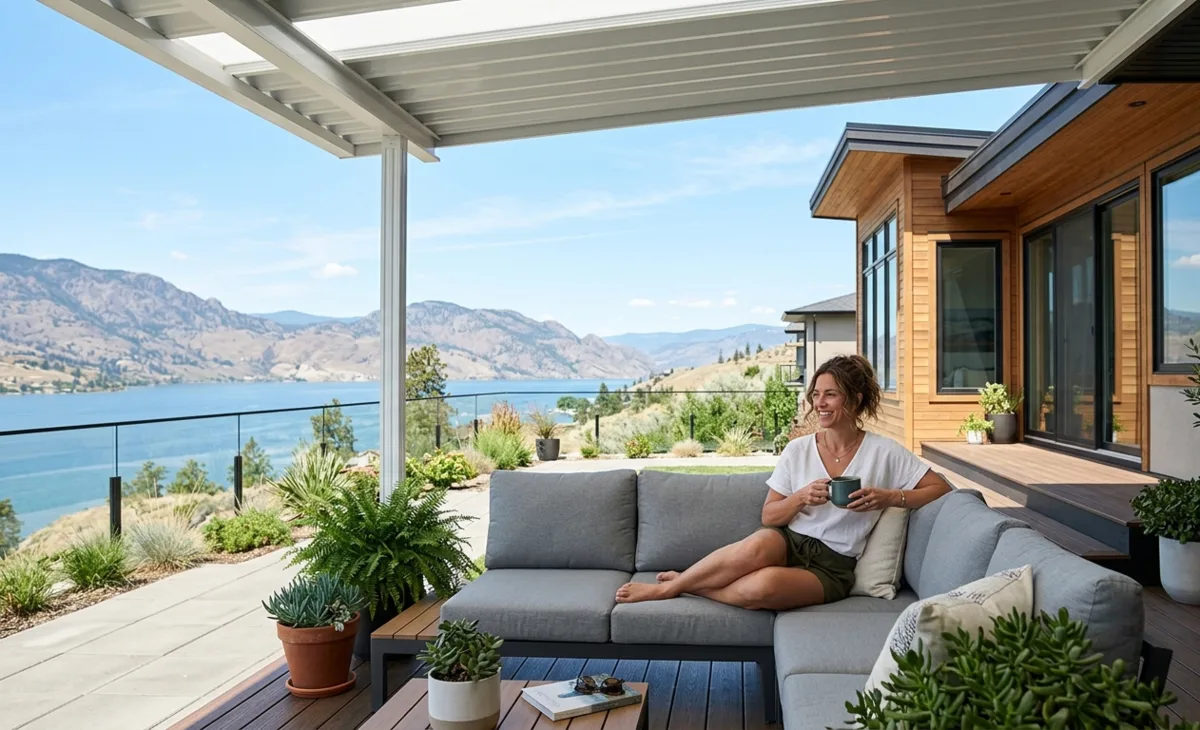
Solid Aluminum Patio Covers: Full Shade, Built for BC Winters
A solid aluminum patio cover blocks 100% of the sun, rain, and snow — so the space underneath stays cooler, dry, and usable from spring through the depths of a BC winter. This guide breaks down what our solid, heavy-gauge aluminum covers do, how they compare to a fully enclosed room, and what they mean for Okanagan homeowners.
Stay cool even on the hottest Okanagan summer days.
What Is a Solid Aluminum Patio Cover?
A solid aluminum patio cover uses heavy-gauge structural aluminum panels that lock together into one continuous, watertight roof. There are no gaps, no slats, and no fabric — just a solid roof that blocks 100% of the sun, rain, and snow over your patio.
Because the panels are solid aluminum, the cover is over-built for BC winters — it sheds heavy snow, won’t rust or rot, and keeps the space underneath dry and shaded. We design, manufacture, and install every cover in-house with our own local crew.
Why Homeowners Choose a Solid Cover
- Full shade: blocks 100% of direct sun, all day
- All-weather: sheds rain and snow so the patio stays dry and usable
For homeowners who want a fully enclosed space they can heat and cool, the next step up is a room with glass walls — but for open-air shade and complete weather protection, a solid aluminum cover is the simplest, toughest choice.
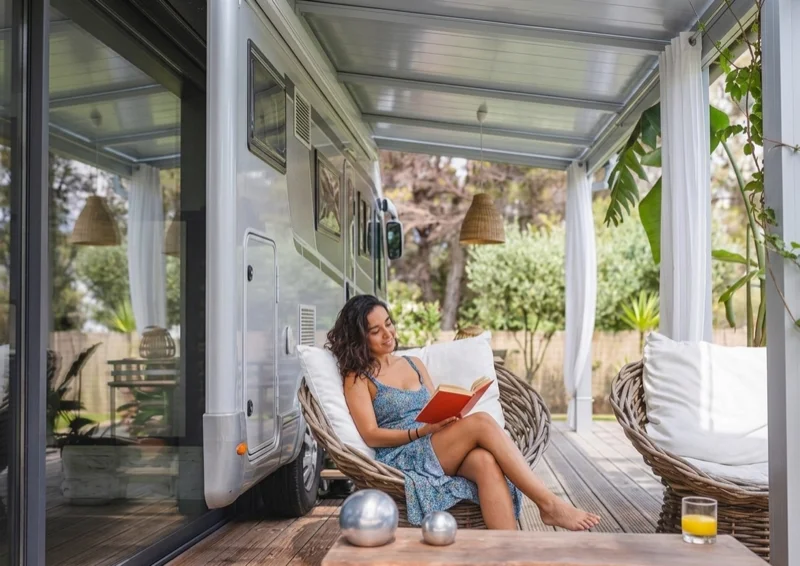
Solid Patio Cover vs an Enclosed Room
A solid aluminum patio cover gives you full shade and complete rain and snow protection over an open-air patio. If you want a fully enclosed space you can heat and cool year-round, that’s a different product — a 3-season room or 4-season sunroom. Here’s how they compare.
| Feature | Solid Aluminum Patio Cover | 3-Season / 4-Season Room |
|---|---|---|
| Build | Solid heavy-gauge aluminum roof, open sides | Fully enclosed with glass walls and a roof |
| Sun & Shade | Blocks 100% of direct sun — full shade | Glass walls, shaded and enclosed |
| Rain & Snow | Sheds rain and snow, keeps the patio dry | Sealed and weather-tight |
| Climate Control | Open-air — naturally cooler in the shade | Heated and cooled for year-round comfort |
| Winter-Tough | Over-built for BC winters | Over-built for BC winters |
| Best For | Open-air shade, rain & snow protection | True year-round, climate-controlled living |
When a Solid Patio Cover Is the Right Call
- You want full shade over your patio or deck all summer
- You want to keep the space dry through rain and snow
- You want an open-air patio, not an enclosed room
- You prefer a clean, finished underside
- You want a low-maintenance roof that won’t rust or rot
When to Step Up to an Enclosed Room
- You want to use the space in the cold months, fully enclosed
- You want heating and cooling for year-round comfort
- You want glass walls to block wind, bugs, and weather
- You’re after an indoor-feeling room, not an open patio
5 Benefits of a Solid Aluminum Patio Cover
1. Full Shade, Cooler Patio
The most noticeable benefit is full, all-day shade. A solid aluminum roof blocks 100% of direct sun, so on a hot Okanagan summer day the space underneath stays noticeably cooler and more comfortable than sitting out in the open.
Solid panels keep the sun off you and your furniture completely — no hot spots, and no fading from direct UV. That’s the difference between comfortable outdoor entertaining and a patio that’s too hot to use.
2. Stays Dry in Any Weather
A solid aluminum cover sheds rain and snow completely, so the patio underneath stays dry and usable through a storm. No gaps, no leaks — just a roof that does its job in any weather.
This is particularly valuable if your patio cover is attached to your home — you get a dry, sheltered transition between the house and the yard, rain or shine.
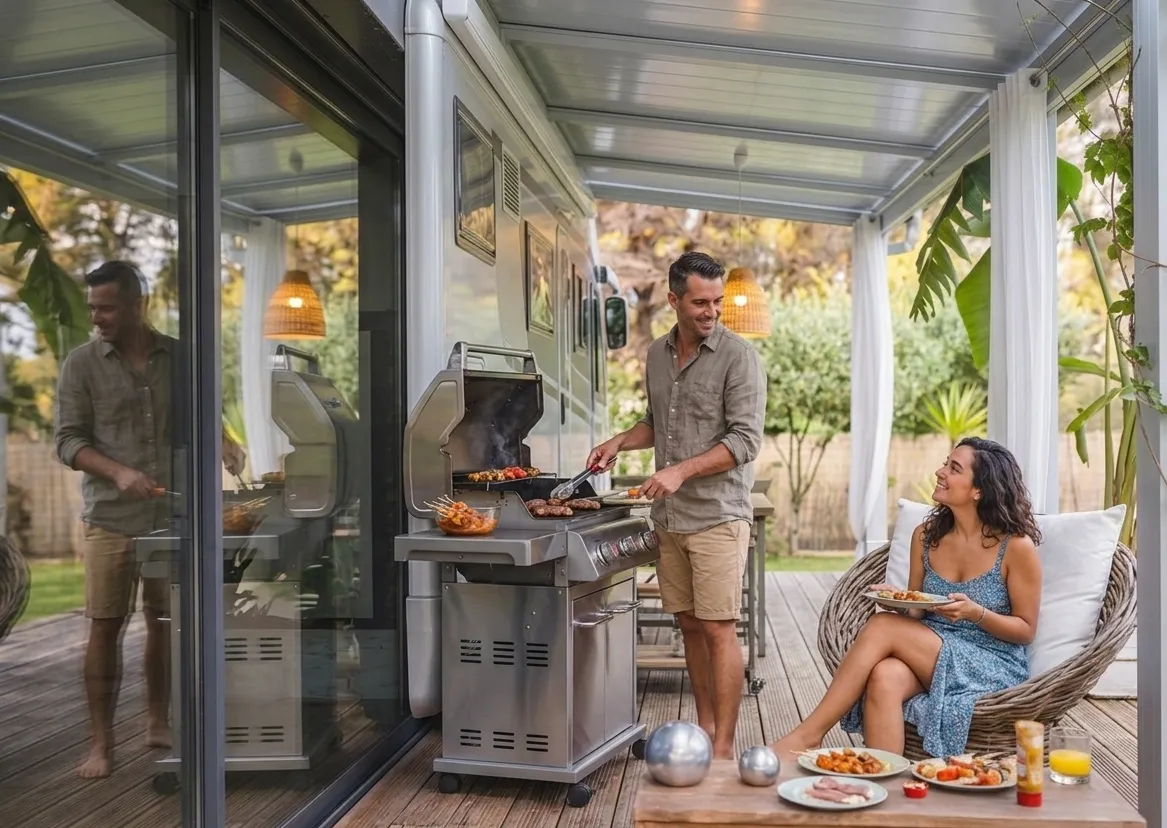
3. Heavy-Gauge, Over-Built for BC Winters
Our covers are built from heavy-gauge structural aluminum and over-built for BC winters. We design and manufacture them in-house to shed Okanagan snow loads and stand up to wind, season after season.
Because everything is made and installed by our own local crew, most covers go up in about a day — and they’re backed by our warranty — 3 years on leaks, 10 years on materials.
4. Finished Appearance
Our solid covers have a smooth, finished underside that looks clean and intentional — available in black, white, or a custom colour match to suit your home.
This matters if you’re creating an outdoor living room, dining area, or entertainment space where aesthetics count.
5. Durable & Low-Maintenance
Solid heavy-gauge aluminum makes our covers tough and over-built for BC winters. Aluminum won’t rust, rot, warp, or peel, so the cover keeps looking and performing well for decades with almost no upkeep.
What Does a Solid Aluminum Patio Cover Cost?
Every project is a little different, so we price each solid aluminum patio cover to your exact size, layout, and finish — with no surprises and no obligation. The best way to get a real number is a free on-site quote.
Because we design, manufacture, and install in-house with our own local crew, you deal with one team from first measurement to final install — and most covers go up in about a day. See our aluminum patio covers or request your free quote.
Installation Process
Installing a solid aluminum patio cover is fast and clean, and we handle the whole thing with our own crew:
Timeline
- Site visit: we measure and confirm the design
- Install day: most covers go up in about a day
- You’re done: we clean up and walk you through it
Electrical Pre-Planning
Want lighting, fans, or heaters under your cover? It’s easiest to plan that before we build, so we can route everything cleanly. Tell us what you have in mind and we’ll design for it from the start.
Common electrical additions:
- Recessed or surface LED lighting
- Ceiling fans
- Outlets for a TV or patio heater
- Low-voltage landscape lighting connections
What to Expect
Our process includes:
- Site visit and measurement
- Custom design and free quote
- Permits: many covers go up with no permit hassle — we’ll tell you exactly what your project needs
- In-house manufacturing
- Installation (most covers in about a day)
- Final walkthrough
Frequently Asked Questions
Why choose a solid aluminum patio cover?
A solid aluminum cover blocks 100% of the sun, rain, and snow, so your patio stays cooler, dry, and usable far more of the year. It’s heavy-gauge, over-built for BC winters, and won’t rust or rot — a low-maintenance roof that lasts for decades. If you want a fully enclosed, climate-controlled space, a 3-season or 4-season room is the step up.
How much cooler is it under a solid aluminum cover?
A solid aluminum roof throws full shade and blocks 100% of direct sun, so the space underneath stays noticeably cooler and more comfortable than sitting out in the open on a hot Okanagan day.
Are your patio covers insulated?
Our patio covers are solid, heavy-gauge aluminum built for full shade and all-weather protection — not climate-controlled enclosures. If you want a fully insulated, heated and cooled space you can use year-round, that’s a 4-season sunroom; for three-season comfort, a 3-season room is the move.
Are your patio covers strong enough for BC winters?
Yes. Our solid aluminum covers are heavy-gauge and over-built for BC winters — they shed heavy snow and stand up to Okanagan wind and weather, season after season, without sagging or leaking.
What are your patio covers made of?
Solid, heavy-gauge structural aluminum — the same tough material throughout, with no fabric, slats, or open gaps. Aluminum won’t rust, rot, warp, or peel, which is why a solid cover lasts for decades with almost no maintenance.
Will a solid cover keep my patio dry?
Completely. A solid aluminum roof sheds rain and snow with no gaps to leak through, so the patio underneath stays dry and usable through any storm — a real advantage if the cover is attached to your home.
How much does a solid aluminum patio cover cost?
Every cover is custom-built to your size, layout, and finish, so pricing depends on your project. The best way to get a real number is a free, no-obligation on-site quote — get in touch and we’ll measure and price it for you.
Can you add lights and fans to a patio cover?
Yes. We can build in recessed LED lighting, ceiling fans, outlets, and patio heaters. It’s best to plan any electrical before we install so we can route everything cleanly from the start.
How long do solid aluminum patio covers last?
Decades. With minimal maintenance, a solid aluminum patio cover keeps performing for the long haul — aluminum won’t rust, rot, or warp — and ours are backed by our warranty — 3 years on leaks, 10 years on materials.
Does a solid cover work in both hot summers and cold winters?
Yes. In summer, full shade keeps the patio cooler and out of the direct sun. In winter, the cover sheds rain and snow and keeps the space dry. It’s over-built for BC winters, so it handles the full Okanagan range, season after season.
Get Your Solid Aluminum Patio Cover Quote
Ready to shade your patio and keep it usable in any weather? We’ll show you cover samples, walk through your options, and give you a free, no-obligation on-site quote.
Get Your Free Quote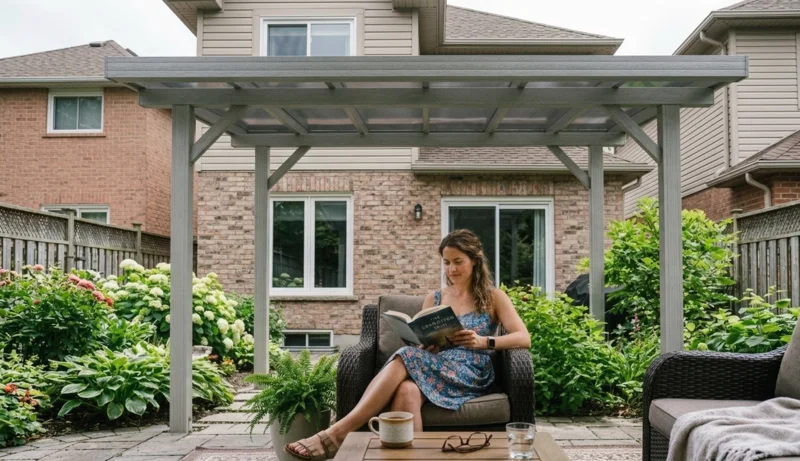
Ready to Start Your Project?
Get a free, no-pressure quote. We’ll help you choose the right solution for your backyard.
Serving Kelowna, West Kelowna, Vernon, Penticton, Lake Country & Salmon Arm