

Deck Railing Height Requirements in BC: 2026 Building Code Guide
Building a deck in the Okanagan? Railing height requirements trip up more homeowners than you might expect. Get it wrong and you’re looking at failed inspections, costly rework, and a project that drags on way longer than it should. This guide breaks down everything the BC Building Code requires for deck railings, guards, and handrails so you can build it right the first time.
When Do You Need a Guard (Railing) on Your Deck in BC?
Here’s the rule that catches people off guard: any deck surface more than 600mm (24 inches) above grade requires a guard railing under the BC Building Code. This measurement is taken from your deck’s walking surface straight down to the ground below.
This requirement applies across the board to decks, balconies, landings, and any elevated platform attached to your home. It doesn’t matter if it’s a small side entrance deck or a sprawling backyard entertaining space. If you’re stepping up more than two feet off the ground, you need a guard.
Now, some folks with lower decks (under 24 inches) think they’re in the clear. Technically, the BC Building Code doesn’t mandate guards for these situations. But here’s what I tell my customers: check with your local municipality anyway. Some areas have stricter requirements, and it’s better to know upfront than discover it during inspection.
BC Deck Railing Height Requirements
The minimum height for your deck railing depends on how high your deck sits above grade. The BC Building Code lays it out pretty clearly:
| Deck Height Above Grade | Minimum Guard Height |
|---|---|
| 600mm to 1.8m (2′ to 5’10”) | 900mm (36 inches) |
| Above 1.8m (5’10″+) | 1,070mm (42 inches) |
Most Okanagan decks sit somewhere between 3 and 4 feet off the ground, which puts them in the 36-inch minimum category. That works out well because 36-inch railings don’t feel too imposing while still providing solid protection.
Two-story decks and balconies are a different story. Once you’re above that 5’10” threshold, you’re in 42-inch territory. This is common for upper-floor balconies and decks built into hillside properties, which we see plenty of around Kelowna and the lake communities.
One thing to keep in mind: some municipalities like Vancouver enforce 42-inch guards across the board, regardless of deck height. Kelowna typically follows the standard BC Building Code requirements, but it’s always worth a quick call to the building department to confirm what applies to your specific project.
Need help choosing the right railing style for your deck? Check out our deck railings in the Okanagan options to see what works best for your home.
Baluster Spacing Requirements: The 4-Inch Rule
This is the one that gets DIYers into trouble more than anything else. The BC Building Code states that no opening in your guard can allow a 100mm (4-inch) sphere to pass through. Think of it as the “baby head test” because that’s exactly what it’s designed to prevent.
This 4-inch rule applies everywhere on your railing:
- Between balusters/pickets: Space them no more than 4 inches apart, center to center won’t cut it here. Measure the actual gap.
- Under the bottom rail: That gap between your bottom rail and the deck surface can’t exceed 4 inches either.
- Decorative openings: Any cut-outs, patterns, or decorative elements must also pass the sphere test.
This requirement holds true regardless of what material you’re using. Wood pickets, metal balusters, glass panels, even cable railings. They all need to prevent a 4-inch sphere from passing through when properly tensioned and installed.
The purpose here is straightforward: keeping small children from slipping through or getting their heads stuck between balusters. It’s one of those requirements that makes complete sense once you understand the why behind it.
Climbing Prevention: Horizontal vs. Vertical Railings
The BC Building Code requires guards to be “difficult for a child to climb.” This has historically caused confusion around horizontal railings, but here’s where things stand now.
The critical climbing zone runs from 100mm to 900mm (4 inches to about 35.5 inches) above the deck surface. Within this zone, your railing design shouldn’t provide footholds that make it easy for a kid to climb.
Recent updates to the BC Building Code have clarified the rules around horizontal railings. They ARE now permitted in BC under these conditions:
- Your deck is less than 4.2 meters (13’9″) above grade
- The spacing still prevents a 4-inch sphere from passing through
- The horizontal elements don’t create an obvious ladder effect
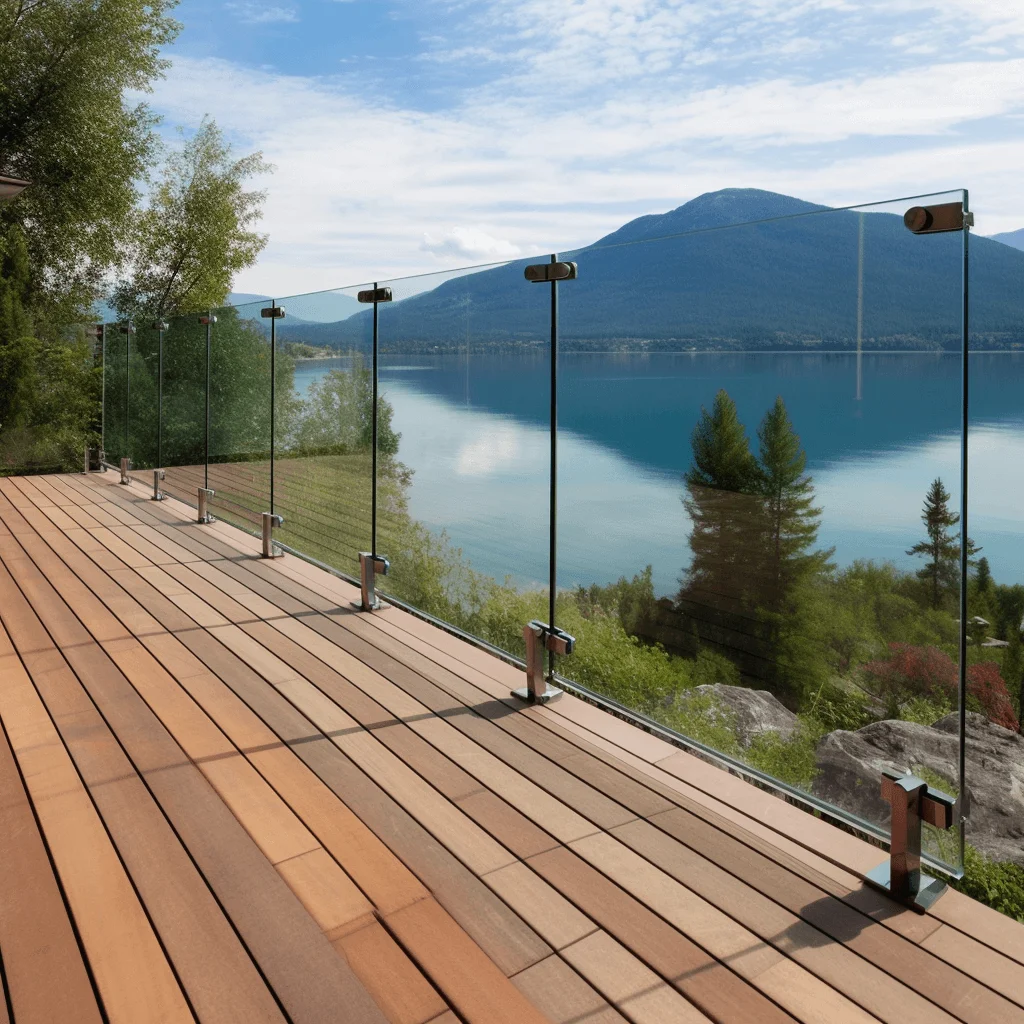
Vertical pickets, solid glass panels, and properly tensioned cable railings are all compliant options that naturally avoid the climbing concern. Glass railings in particular have become popular in the Okanagan because they eliminate climbing concerns entirely while preserving those lake and valley views.
Glass railings eliminate climbing concerns entirely and showcase those Okanagan views. Learn about our glass patio covers and railings if you’re considering this option.
Handrail Requirements for Deck Stairs
Deck stairs have their own set of rules, and they’re separate from guard requirements. Here’s what the code says:
Exterior stairs with 4 or more risers require a handrail. This is measured by counting steps, not the total height. Three steps? You’re fine without a handrail (though one’s still a good idea). Four or more? It’s mandatory.
The handrail height must be between 900mm and 1,070mm (35 to 42 inches), measured from the stair nosing vertically up to the top of the handrail. This measurement follows the slope of the stairs, not a single point.
The handrail must be continuously graspable throughout the entire stair length. This is where I see a lot of homeowner-built stairs fail inspection. A flat 2×4 or 2×6 board doesn’t qualify as graspable because you can’t wrap your hand around it properly. You need a proper handrail profile that someone can grip if they start to stumble.
There also needs to be at least 2 inches of clearance between the handrail and any wall or post. This ensures someone can actually get their hand around the rail in an emergency.
One important distinction: handrails and guards serve different purposes. Your stair may need both. The guard (railing) prevents falls off the side of the staircase, while the handrail gives you something to hold onto as you go up and down.
Load Requirements: How Strong Must Your Railing Be?
A railing that looks solid isn’t necessarily code-compliant. The BC Building Code specifies load requirements that every guard must meet, found in Table 9.8.8.2.
For residential decks, your railing must withstand:
- Horizontal load along the top: 0.75 kN/m (about 51 pounds per linear foot)
- Concentrated point load: 1.0 kN (225 pounds) applied at any location
These numbers simulate real-world scenarios: someone leaning heavily against the rail, a group of people all pressing against one section, or someone falling into the railing. Your guard needs to handle these forces without failure.
This is where DIY railings often come up short. The railing might look sturdy, but the post connections, the hardware used, and the overall structural design all factor into whether it will pass a load test. Toenailing posts to the deck frame, for example, almost never provides adequate load-bearing capacity.
Professional installation ensures proper post connections (typically using through-bolts or approved brackets), appropriate materials, and structural integrity that will pass inspection. It’s not just about appearance. It’s about your family’s safety.
Common Code Violations That Fail Inspection
After years of installing deck railings around Kelowna, I’ve seen the same mistakes come up over and over. Here are the violations inspectors catch most often:
- Railing too short: Using 36-inch railings when the deck height requires 42 inches. Always verify your deck height before ordering materials.
- Baluster spacing too wide: Gaps larger than 4 inches between pickets. This is an instant fail.
- Bottom rail gap: Space under the bottom rail exceeding 4 inches. Easy to overlook during installation.
- Improper handrail profile: Flat boards on stairs that can’t be gripped properly. You need a shaped handrail.
- Weak post connections: Toenailing instead of proper brackets or through-bolts. Posts need to resist horizontal loads.
- Climbable design: Horizontal elements in the climbing zone that create a ladder effect.
- Wrong materials: Some vinyl railings don’t meet load requirements. Check manufacturer specs.
- Missing guards entirely: Assuming lower decks (24-30 inches) don’t need them when they do.
The consequences of failed inspections go beyond inconvenience:
- Your project gets halted until corrections are made
- Unpermitted work can result in fines that run into the thousands
- Your homeowner’s insurance may not cover accidents on non-compliant structures
- You’ll face disclosure issues when selling your home
Kelowna & RDCO Permit Requirements
If you’re building a deck in Kelowna or the Central Okanagan, here’s what you need to know about permits.
The City of Kelowna requires building permits for decks where the surface height is greater than 0.6m (24 inches) above grade. Sound familiar? That’s the same threshold where guards become mandatory. If you need a railing, you almost certainly need a permit.
For properties outside city limits, the Regional District of Central Okanagan (RDCO) has similar requirements. Rural properties in Lake Country, West Kelowna, and unincorporated areas fall under RDCO jurisdiction.
Permit applications typically require:
- A site plan showing deck location relative to property lines and buildings
- Construction drawings with railing details and specifications
- Guard railing design specifications including materials and hardware
Inspections happen at various stages of construction, and the final inspection specifically checks railing compliance. Having your documentation in order before you start saves headaches later.
Working with an experienced contractor who knows the local codes inside and out streamlines the entire permit process. We handle the paperwork, know what inspectors look for, and can answer their questions on the spot.
Choosing Code-Compliant Railing Materials
Different materials offer different advantages, but they all need to meet the same code requirements. Here’s how the options stack up:
| Material | Advantages | Code Considerations |
|---|---|---|
| Aluminum | Durable, low maintenance, many styles available | Most systems meet code easily. Powder coating lasts in Okanagan climate. |
| Glass | Unobstructed views, modern look, no climbing risk | Must be tempered or laminated, minimum 12mm thick. Passes all requirements. |
| Wood | Traditional appearance, DIY-friendly for some | Requires proper post connections. Inspect for rot regularly. |
| Cable | Modern aesthetic, open feel | Must pass 4-inch sphere test when tensioned. Requires periodic re-tensioning. |
| Composite | Weather resistant, many colors | Check manufacturer load ratings. Not all systems qualify. |
For the Okanagan climate with hot summers and cold winters, aluminum and glass railings tend to hold up best over time. Wood requires more maintenance to prevent weathering, while composites can fade with intense sun exposure if you don’t choose quality materials.
See our full range of deck railing options available in Kelowna and throughout the Okanagan Valley.
Frequently Asked Questions
What is the minimum deck height that requires a railing in BC?
Any deck surface more than 600mm (24 inches) above the ground requires a guard (railing) under the BC Building Code. This measurement is taken from the deck walking surface straight down to grade. If your deck is 2 feet or higher off the ground, you need a railing. There’s no exception for small decks or low-traffic areas.
Can I install horizontal railings on my deck in BC?
Yes, horizontal railings are now permitted in BC under recent code updates. Your deck must be less than 4.2 meters (13’9″) above grade, and the spacing between horizontal elements must still prevent a 4-inch sphere from passing through. The design shouldn’t create an obvious ladder effect in the climbing zone (4 inches to 35.5 inches above deck). Many modern horizontal designs meet these requirements when properly installed.
Do I need a permit to replace my deck railing in Kelowna?
Generally, replacing railings on an existing permitted deck may not require a new permit if you’re maintaining the same basic design and location. However, adding railings where none existed, significantly changing the design, or working on a deck that was never permitted should be confirmed with the City of Kelowna Building Department. When in doubt, a quick phone call can save you from complications during a future home sale or insurance claim.
What happens if my deck railing doesn’t meet code?
If an inspection reveals non-compliant railings, work must stop until corrections are made. For existing decks with unpermitted or non-compliant railings, you may face fines, be required to obtain retroactive permits, or in severe cases, be ordered to remove the non-compliant structure. Beyond legal issues, your homeowner’s insurance may deny claims for injuries that occur on non-compliant structures. It can also create problems when you try to sell your home.
Is 36 inches or 42 inches required for deck railings in BC?
It depends on your deck height above grade. Decks between 24 inches and 5’10” (1.8m) above ground require a minimum 36-inch guard height. Decks higher than 5’10” require 42-inch guards. Most typical Okanagan backyard decks fall into the 36-inch category, while upper-floor balconies and hillside decks often require the taller 42-inch guards. When in doubt, 42 inches meets all requirements.
Do stairs from my deck need a handrail?
Yes, exterior stairs with 4 or more risers require a graspable handrail. The handrail must be between 900mm and 1,070mm (35 to 42 inches) high, measured from the stair nosing. It must be continuously graspable, meaning you can wrap your hand around it. Flat boards like 2x4s don’t qualify. You may also need a guard (protective railing) on the sides of the staircase, which is separate from the handrail requirement.
Can I do my own deck railing installation?
DIY installation is possible, but your railings must still meet all BC Building Code requirements and pass inspection. The most common issues with DIY railings are inadequate post connections that don’t meet load requirements, improper baluster spacing, and using materials that don’t have the required structural ratings. Professional installation ensures code compliance, proper load-bearing capacity, and typically includes handling the permit process. For many homeowners, the peace of mind and warranty protection make professional installation worthwhile.
Need Help With Code-Compliant Deck Railings?
We handle permits, installation, and inspections for deck railings throughout Kelowna and the Okanagan Valley. Get it right the first time.
Get Your Free QuoteReady to Start Your Project?
Get a free, no-pressure quote. We’ll help you choose the right railing solution for your deck.
Serving Kelowna, West Kelowna, Vernon, Penticton, Lake Country & Salmon Arm