

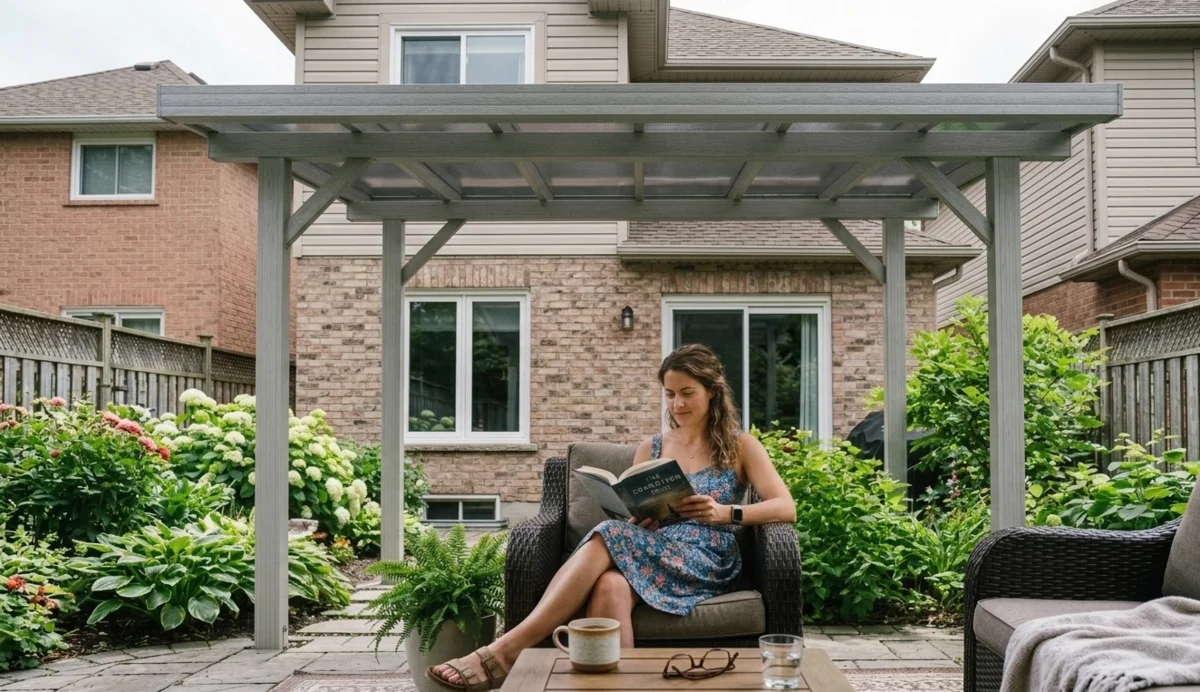
Patio Covers for Rain & Snow in BC (2026 Guide): Best Options & Snow Load Ratings
British Columbia’s weather throws everything at outdoor structures — heavy snow loads in winter, torrential rain in spring and fall, and intense sun in summer. A patio cover that works in Arizona won’t necessarily survive an Okanagan winter. This guide covers the technical requirements and design features that make patio covers truly weather-ready for BC conditions.
Enjoy your outdoor space rain or shine — even during BC’s wettest months.
Understanding Snow Load Ratings
Snow load is the weight of accumulated snow that a structure must support, measured in kilopascals (kPa) or pounds per square foot (psf). The BC Building Code specifies minimum snow load ratings based on location and elevation.
Okanagan Snow Load Requirements
| Location | Ground Snow Load (kPa) | Roof Snow Load (psf) |
|---|---|---|
| Kelowna | 2.4 kPa | ~50 lbs/sq ft |
| West Kelowna | 2.6 kPa | ~54 lbs/sq ft |
| Vernon | 3.0 kPa | ~63 lbs/sq ft |
| Penticton | 1.8 kPa | ~38 lbs/sq ft |
| Salmon Arm | 3.2 kPa | ~67 lbs/sq ft |
| Lake Country | 2.8 kPa | ~58 lbs/sq ft |
| Higher Elevations (1000m+) | 4.0-4.8 kPa | ~84-100 lbs/sq ft |
What do these numbers mean? A patio cover in Kelowna must support approximately 50 pounds per square foot of snow. For a 200 sq ft cover, that’s 10,000 pounds of snow weight — equivalent to five compact cars.
Ground Snow Load vs Roof Snow Load
The BC Building Code specifies ground snow load, but patio covers experience roof snow load, which is typically lower due to wind drift, melting, and slope. Engineers apply reduction factors, but your cover must still be designed for your specific location’s requirements.
Drainage Design for Heavy Rain
A patio cover must shed water efficiently to prevent pooling, leaks, and structural stress. Proper drainage involves three key factors: slope, gutters, and downspout placement.
Slope Requirements
The minimum slope for patio cover drainage is typically 1/4 inch per foot (1:48 ratio). This means a 12-foot-deep cover should drop at least 3 inches from the high side to the low side.
Steeper slopes (1/2” per foot or more) drain faster and handle heavy rain better. For attached covers, the slope typically runs away from the house toward the outer edge where gutters collect the water.
Gutter Integration
Quality patio covers have integrated gutter channels built into the structure — not afterthought add-ons. These channels run along the beams and connect to downspouts at the corners.
Gutter capacity matters: Undersized gutters overflow during heavy rain, causing waterfall effects off the edge. We size gutters for BC’s rainfall intensity, which can exceed 25mm (1 inch) per hour during storms.
Downspout Placement
Downspouts should direct water away from:
- The foundation of your home
- Patio surfaces where pooling could occur
- Neighboring properties
Consider connecting downspouts to underground drainage or French drains for clean water management.
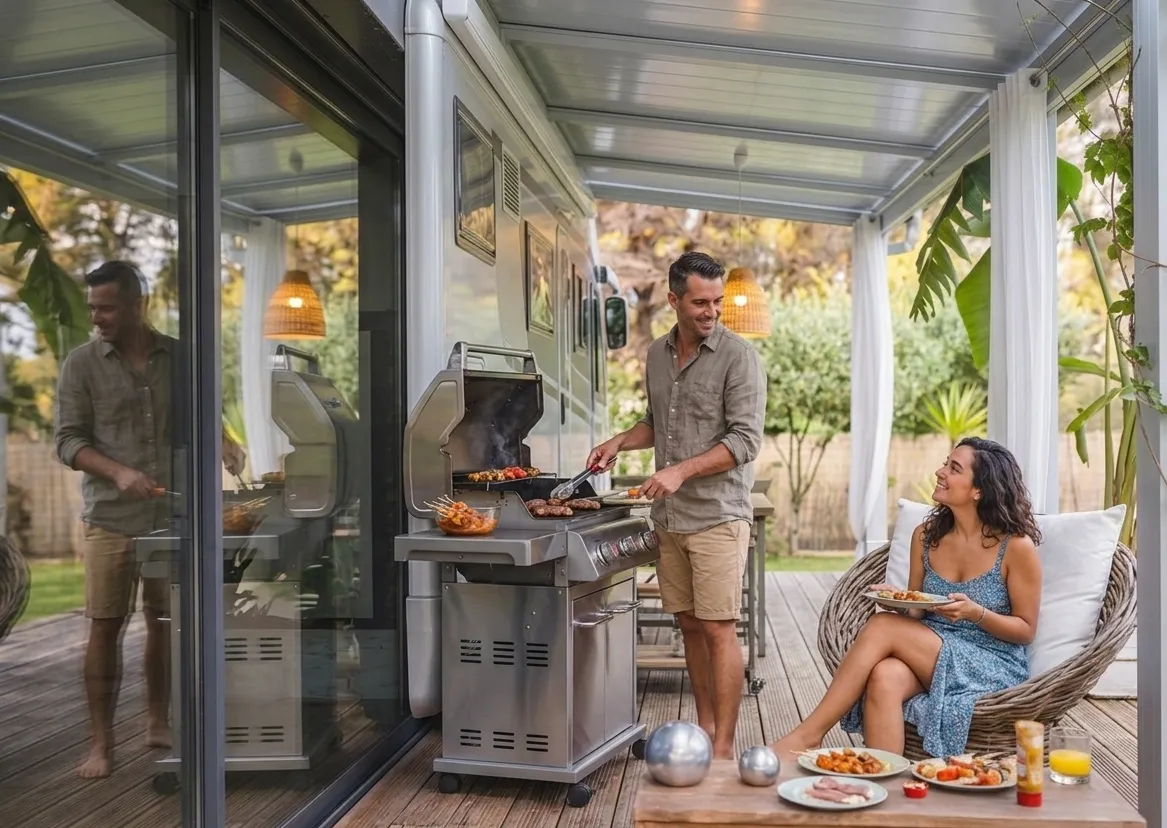
Best Patio Cover Materials for BC Weather
| Material | Rain Performance | Snow Load Capacity | Durability | Maintenance |
|---|---|---|---|---|
| Aluminum (Insulated) | Excellent | High (engineered) | 30-40+ years | Minimal |
| Aluminum (Non-Insulated) | Excellent | Medium-High | 30+ years | Minimal |
| Glass Panels | Excellent | Medium | 25+ years | Cleaning required |
| Wood/Timber | Good (with sealant) | High (if engineered) | 15-25 years | Regular staining/sealing |
| Fabric/Canvas | Limited | Low (must be retracted) | 5-10 years | High |
| Polycarbonate | Good | Low-Medium | 10-15 years | Cleaning required |
Our recommendation for BC: Aluminum patio covers (insulated or non-insulated) offer the best combination of weather performance, durability, and low maintenance for Okanagan conditions. They won’t rot, rust, or require ongoing treatment like wood.
5 Features That Handle Okanagan Weather
1. Insulated Panels
Insulated sandwich panels (foam core between aluminum sheets) provide three weather-related benefits:
- Snow load capacity: Stronger than single-layer panels
- Noise reduction: Rain sounds muted, not like a drum
- Temperature management: Prevents heat radiation in summer, condensation in winter
2. Proper Flashing
For attached patio covers, the connection to your house is the most vulnerable point for water intrusion. Proper flashing includes:
- Ledger board flashing: Metal flashing above the ledger that directs water away
- Kickout flashing: Directs water into gutters rather than behind the cover
- Sealant: Appropriate caulking rated for outdoor temperature extremes
3. Reinforced Structure
BC snow loads require beefier structural members than covers designed for mild climates:
- Larger beam dimensions: 4” or 6” beams instead of 3”
- Closer spacing: Rafters at 24” on center or less
- Engineered connections: Proper brackets and fasteners rated for loads
- Adequate footings: Concrete piers below frost line (4+ feet deep)
4. Integrated Gutters
Built-in gutter channels that are part of the beam profile perform better than add-on gutters:
- No separate pieces to fail or detach
- Seamless appearance
- Sized appropriately for the roof area
- Concealed fasteners that won’t leak
5. Powder-Coated Finish
Aluminum is naturally corrosion-resistant, but powder coating adds:
- UV protection: Prevents fading and chalking
- Additional corrosion barrier: Especially important near pools or in marine environments
- Color retention: Maintains appearance for decades
- Easy cleaning: Smooth surface sheds dirt and debris
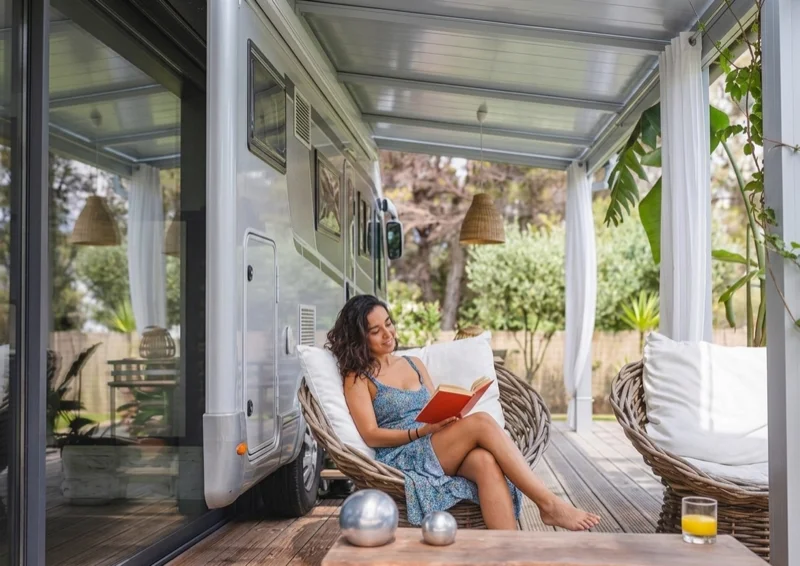
Common Weather-Related Problems (And How to Avoid Them)
Leaking at House Connection
The problem: Water seeps between the patio cover and house wall, running down the exterior or entering the home.
The cause: Improper or missing flashing, deteriorated caulk, or ledger board installed without proper waterproofing.
The solution: Proper flashing installation with a metal drip edge above the ledger board, quality exterior-rated sealant, and regular inspection/maintenance of the connection point.
Sagging Under Snow
The problem: The patio cover roof bows downward under snow weight, potentially collapsing or suffering permanent deformation.
The cause: Structure not engineered for local snow loads, undersized beams or rafters, or span too long without support.
The solution: Ensure your cover is engineered for your location’s snow load requirements. This may mean larger beams, closer rafter spacing, or additional support posts for longer spans.
Water Pooling
The problem: Water collects on the roof surface instead of draining, adding weight and potentially leaking through seams.
The cause: Insufficient slope, clogged gutters, or sagging that creates low spots.
The solution: Minimum 1/4” per foot slope, regular gutter cleaning, and proper structural support to prevent sagging.
Ice Dams
The problem: Ice builds up at the edge of the roof, preventing drainage and potentially backing water under panels.
The cause: Heat loss from below melts snow, which refreezes at the cold edge. More common with attached covers near heated spaces.
The solution: Adequate slope for water to drain before freezing, insulated panels to reduce heat transfer, and sufficient overhang for ice to form away from vulnerable areas.
Frequently Asked Questions
What is the snow load requirement for my area in BC?
Snow load requirements vary by location and elevation. Kelowna requires 2.4 kPa (~50 psf), Vernon requires 3.0 kPa (~63 psf), and higher elevations may require 4.0+ kPa (~84+ psf). Always verify with your local building department or use the BC Building Code tables.
How much snow can an aluminum patio cover hold?
Properly engineered aluminum patio covers can handle 50-100+ lbs per square foot depending on design. Standard off-the-shelf kits are often rated for only 20-30 psf, which may be insufficient for BC conditions. Always verify the snow load rating.
Do I need to remove snow from my patio cover?
If your cover is properly engineered for your location’s snow load, you shouldn’t need to remove snow under normal conditions. However, after exceptional snowfalls exceeding design loads, removal may be prudent. Never use metal tools that could damage the surface.
What slope is needed for patio cover drainage?
The minimum recommended slope is 1/4 inch per foot. For a 12-foot-deep cover, this means at least a 3-inch drop from high side to low side. Steeper slopes (1/2” per foot) provide faster drainage and better performance in heavy rain.
Will my patio cover leak in heavy rain?
A properly installed patio cover with adequate slope, integrated gutters, and correct flashing should not leak. Leaks typically result from installation errors — particularly at the house connection point — or from clogged gutters causing overflow.
What happens if a patio cover exceeds its snow load?
Exceeding design snow load can cause sagging, permanent deformation, connection failures, or in extreme cases, collapse. This is why engineering for your specific location’s requirements is critical, not optional.
Are patio covers rated for Okanagan winters?
Not all patio covers are rated for Okanagan snow loads. Big box store kits are often designed for mild climates. We engineer our covers specifically for BC Building Code requirements in your exact location.
How do I prevent ice dams on my patio cover?
Adequate slope (so water drains before freezing), insulated panels (to reduce heat transfer), and sufficient overhang all help prevent ice dams. Keeping gutters clear is also essential so water can drain freely.
What’s the difference between ground snow load and roof snow load?
Ground snow load is the weight of snow on the ground, specified in building codes. Roof snow load (what structures must support) is typically lower due to wind, melting, and slope factors. Engineers apply reduction factors based on roof geometry and exposure.
Do glass patio covers handle snow well?
Glass patio covers can handle moderate snow loads when properly engineered with tempered glass and reinforced framing. However, they typically have lower load ratings than solid aluminum covers and may require steeper slopes for snow to slide off.
Weather-Ready Patio Covers in the Okanagan
We build patio covers engineered specifically for BC weather conditions — snow loads, rainfall, and temperature extremes. Every cover is designed for your location’s requirements.
Get Your Free Quote Ready to Start Your Project?
Get a free, no-pressure quote. We’ll help you choose the right solution for your backyard.
Serving Kelowna, West Kelowna, Vernon, Penticton, Lake Country & Salmon Arm