


Sunroom vs 3-Season Room: What’s the Difference in BC?
Planning an enclosed outdoor space? The terminology gets confusing fast. Sales reps throw around “sunroom,” “3-season room,” and “solarium” like they’re interchangeable—but they’re not. The difference between a 3-season room and a 4-season sunroom comes down to one thing: can you use it when it’s -15°C outside?
This guide breaks down exactly what separates these two options, with real costs for Okanagan homeowners, local climate data, and the permit requirements you’ll need to navigate. Whether you’re leaning toward a budget-friendly 3-season enclosure or a full-fledged heated addition, you’ll walk away knowing which makes sense for your home.
Quick Answer: The Key Differences
Before we get into the details, here’s the simple version: a 3-season room is an enclosed patio you use from spring through fall. A 4-season sunroom is a heated room addition you use year-round. Everything else—cost, permits, construction—flows from that fundamental difference.
| Factor | 3-Season Room | 4-Season Sunroom |
|---|---|---|
| Use Period | April–October (7 months) | Year-round |
| Heating | None (portable only) | Full HVAC connection |
| Insulation | Minimal or none | Full wall/roof insulation |
| Windows | Single-pane or screen | Double/triple-pane thermal |
| Cost Range | $12,000–$35,000 | $30,000–$80,000+ |
| Permit Level | Often simpler | Full building permit |
| Foundation | Existing patio/slab common | Frost-protected required |
An enclosed outdoor space designed for use during spring, summer, and fall. Features screen or glass walls without insulation or heating. Typical cost in the Okanagan: $12,000–$35,000.
A fully insulated, heated addition to your home usable year-round. Requires building permits and HVAC connection. Typical cost in the Okanagan: $30,000–$80,000+.
3-Season Rooms Explained
What Is a 3-Season Room?
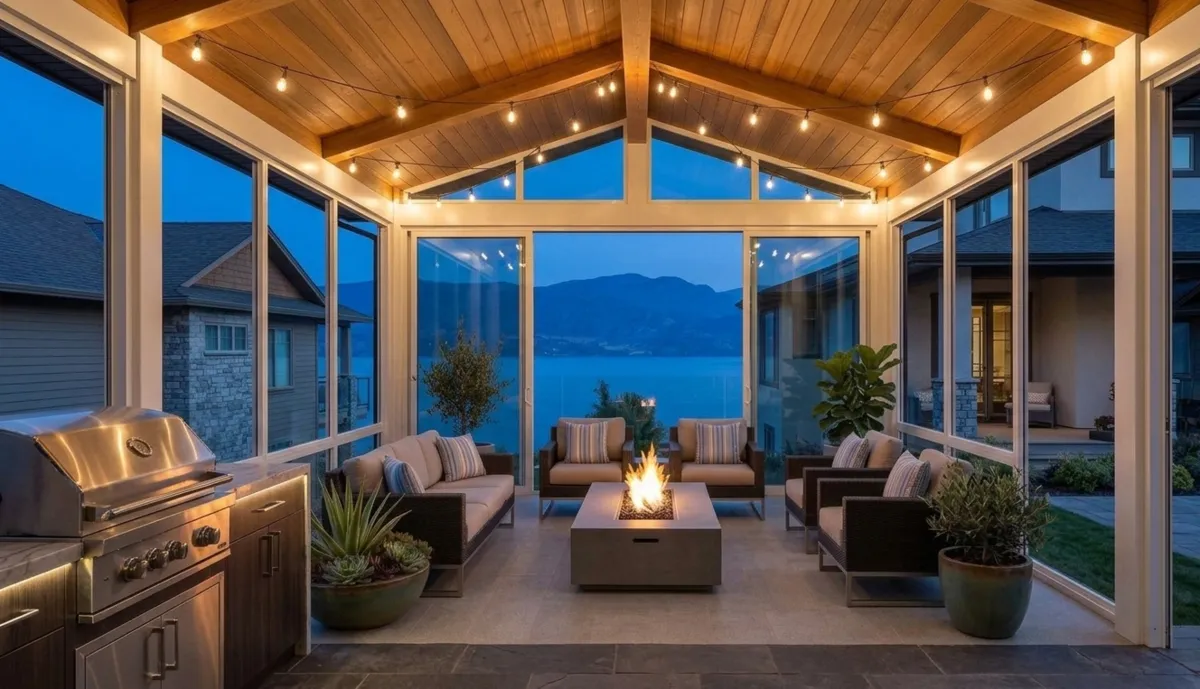
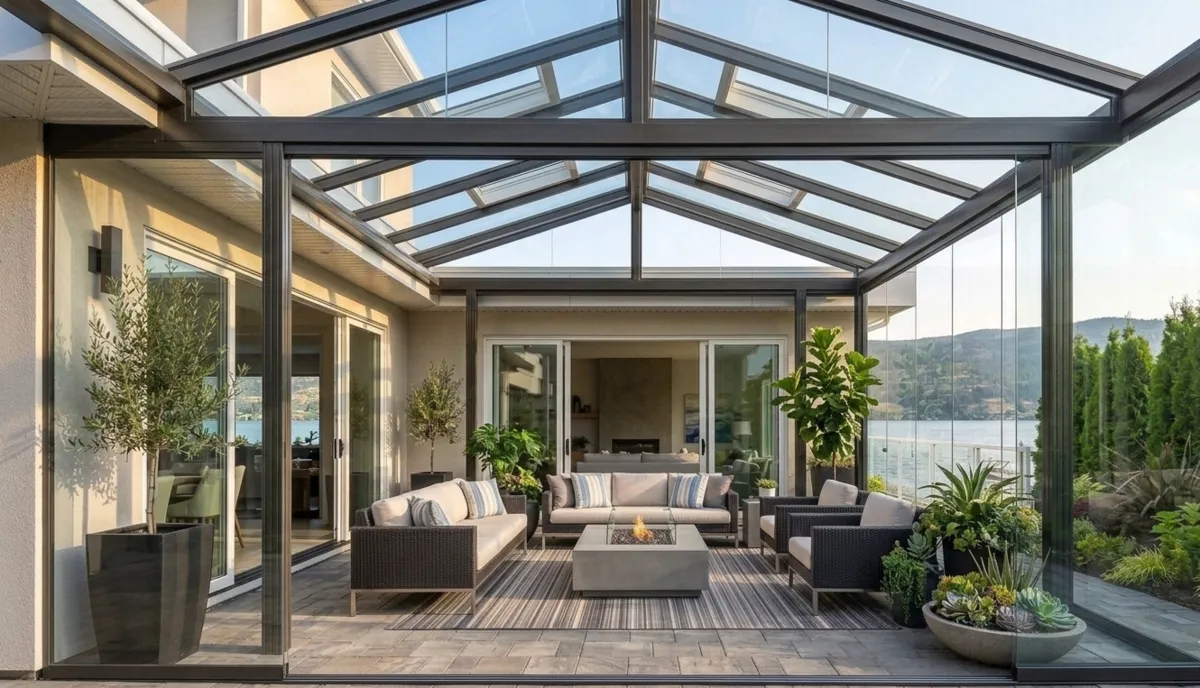
A 3-season room is essentially an enclosed porch or patio. You get walls, a roof, and protection from bugs and rain—but no heating system and minimal (if any) insulation. Think of it as bringing your patio furniture indoors while still feeling connected to the outdoors.
You might hear these called sunrooms, screen rooms, or enclosed porches. The naming is inconsistent across the industry, which is part of why this gets confusing. What matters isn’t the name—it’s whether the structure has heating and insulation.
Temperature Range in the Okanagan
Here’s the practical reality for Okanagan homeowners:
- Comfortable use: When it’s 10°C+ outside (typically April through October)
- Extended season: A glass-walled room stays usable 2–4 weeks longer than an open patio
- Winter storage: Your furniture stays protected from snow and rain
- Summer heat: Can reach 35°C+ on hot afternoons—ventilation is critical
Types of 3-Season Rooms
Not all 3-season rooms are built the same. Your options include:
- Screen rooms: Mesh walls provide maximum airflow at the lowest cost. Great for bug protection but no weather barrier.
- Glass rooms: Single-pane vinyl windows keep out wind and rain. More weather protection, higher cost.
- Hybrid systems: Screen panels swap out for glass seasonally. Flexibility at moderate cost.
- Louvered roof: Adjustable aluminum louvers over glass or screen walls. Premium option with the most control.
Pros and Cons
What you gain:
- 40–60% lower cost than a 4-season room
- Simpler permit process (often just a building permit)
- Can often use your existing patio or deck as the foundation
- Excellent space for entertaining during warm months
- Protection from bugs, rain, and light wind
What you give up:
- Winter use (unless you’re comfortable in a parka)
- Year-round living space value
- Can overheat without proper ventilation
- Generally adds less to home resale value than a 4-season room
4-Season Sunrooms Explained
What Is a 4-Season Sunroom?
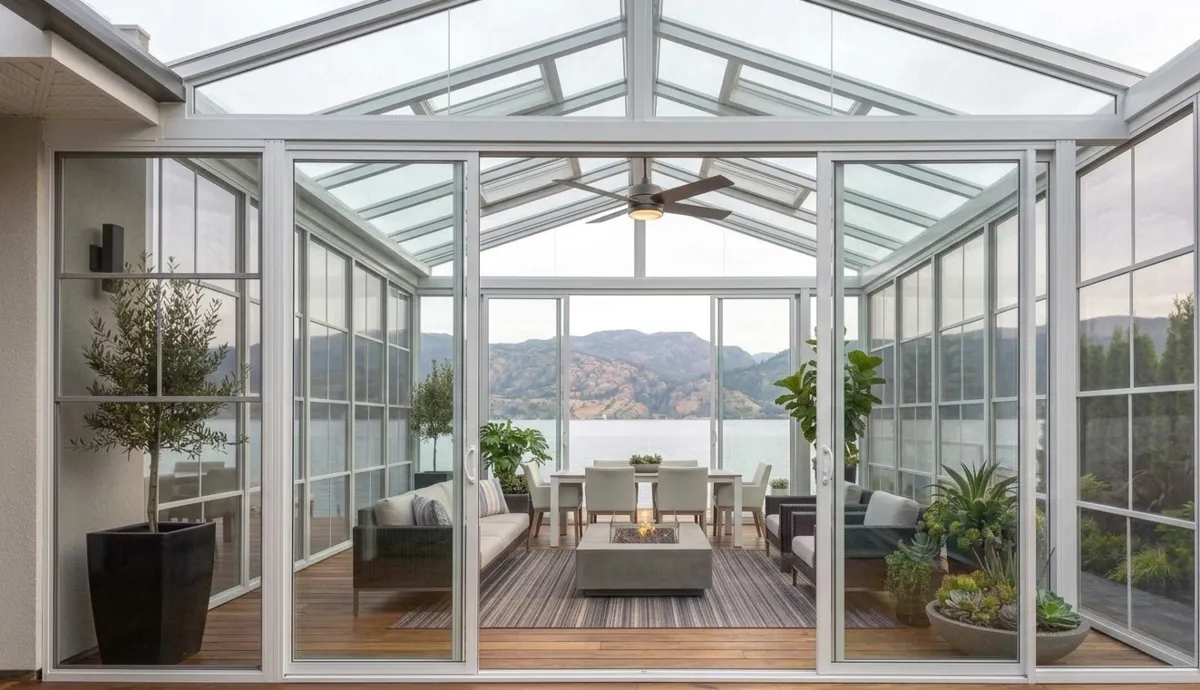
A 4-season sunroom is a true room addition. Insulated walls and roof, double or triple-pane thermal windows, and a connection to your home’s heating and cooling system. It’s a legitimate living space you can use at -20°C without discomfort.
The construction is fundamentally different from a 3-season room. You need a frost-protected foundation (4 feet deep in the Kelowna area), insulation that meets BC Building Code requirements, and mechanical systems that handle climate control.
Why “Year-Round” Matters in BC
The Okanagan isn’t coastal Vancouver. Our winters regularly hit -10°C to -20°C, and an uninsulated space becomes unusable for 4–5 months of the year.
A properly built 4-season room maintains 20°C+ inside even when it’s -15°C outside. That requires:
- Wall insulation: R-20 minimum
- Roof insulation: R-30 or higher
- Floor insulation: R-10 minimum over frost-protected foundation
- Windows: Double-pane Low-E at minimum; triple-pane recommended
Construction Requirements
Building a 4-season sunroom isn’t a weekend project. Expect:
- Foundation: Excavated below frost line (4 feet in Kelowna)
- Framing: 2×6 walls to accommodate insulation depth
- Windows: Double-pane minimum, Low-E coating recommended
- HVAC: Extension of existing system or dedicated mini-split
- Electrical: Full permit required for outlets, lighting, and switches
Pros and Cons
What you gain:
- True year-round living space
- Adds heated square footage to your home
- Higher home value increase (60–80% ROI at resale)
- Functions as a real room—heated, lit, fully usable
What you give up:
- 2–3x the cost of a 3-season room
- Full building permit with multiple inspections
- Longer construction timeline (4–8 weeks typical)
- May require HVAC upgrades to your existing system
- Property taxes may increase (additional conditioned space)
Cost Comparison (Okanagan-Specific)
These are real-world costs for the Kelowna and surrounding area as of early 2026. Vancouver or Victoria prices will be higher; rural BC may be slightly lower.
3-Season Room Costs
| Size | Basic (Screen) | Mid (Glass) | Premium (Louvered) |
|---|---|---|---|
| 10’ x 12’ | $12,000–$16,000 | $16,000–$22,000 | $22,000–$28,000 |
| 12’ x 16’ | $16,000–$22,000 | $22,000–$30,000 | $30,000–$40,000 |
| 16’ x 20’ | $22,000–$30,000 | $30,000–$42,000 | $42,000–$55,000 |
What’s included: Structure, walls or screens, basic roof, standard doors.
Common add-ons:
- New deck or foundation: +$5,000–$15,000
- Electrical (outlets, lighting): +$2,000–$4,000
- Upgraded flooring: +$2,000–$5,000
4-Season Sunroom Costs
| Size | Standard | Premium | Custom |
|---|---|---|---|
| 10’ x 12’ | $30,000–$40,000 | $45,000–$55,000 | $60,000+ |
| 12’ x 16’ | $40,000–$55,000 | $60,000–$75,000 | $85,000+ |
| 16’ x 20’ | $55,000–$75,000 | $80,000–$100,000 | $120,000+ |
What’s included: Foundation, insulated structure, thermal windows, HVAC connection, electrical, drywall finish.
Permit Requirements in BC
This is where a lot of homeowners get caught off guard. Both types of rooms typically require permits, but the process differs significantly.
3-Season Room Permits
- Attached to home: Building permit required
- Freestanding over 10m²: Building permit required
- On existing deck: May require engineering review of deck capacity
- Typical approval timeline: 2–4 weeks
- Typical cost: $200–$500
4-Season Sunroom Permits
- Always required: Full building permit
- Additional permits: Electrical permit, possibly plumbing if applicable
- Engineering: Often required for foundation and structure
- Inspections: Multiple stages (footing, framing, insulation, final)
- Typical approval timeline: 4–8 weeks
- Typical cost: $500–$1,500
Kelowna: (250) 469-8600
West Kelowna: (778) 797-8830
Vernon: (250) 545-1361
Penticton: (250) 490-2501
Which Is Right for Your Okanagan Home?
Choose a 3-Season Room If:
- Your primary use is entertaining during warm months
- Your budget is under $40,000
- You want a faster, simpler project (6–8 weeks vs 3–4 months)
- Your existing patio or deck can support the structure
- You’re comfortable with seasonal use (April through October)
Choose a 4-Season Sunroom If:
- You want usable living space year-round
- Your budget is $50,000 or more
- You’re treating this as a true home addition
- Adding resale value is a priority
- You need the space functional during Okanagan winters
The Hybrid Approach
Some homeowners build a high-quality 3-season room now with plans to upgrade later. If you’re considering this path:
- Build with a proper foundation from the start (even if code doesn’t require it)
- Use insulated aluminum framing that can accept upgraded windows
- Plan your HVAC runs during initial construction
- Accept that you’ll pay more upfront—but less than rebuilding from scratch
This approach typically costs 15–25% more than a basic 3-season room but saves 40–60% compared to a full rebuild later.
Frequently Asked Questions
Can I heat a 3-season room with a space heater?
Portable heaters can extend use into shoulder seasons, but without insulation, you’re wasting energy and still feeling cold below 5°C outside. A space heater might keep you comfortable on a 8°C October evening. At -10°C in January? You’ll be cold no matter how many heaters you run. For reliable winter use, you need a properly insulated 4-season room.
Does a sunroom add value to my home in BC?
Yes. A quality 4-season sunroom typically returns 60–80% of its cost at resale. 3-season rooms add less value but still improve buyer appeal—outdoor living is a top priority for Okanagan buyers. The key is quality: a well-built room from a reputable contractor adds value; a DIY enclosure that leaks or looks cheap can actually hurt resale.
How long does a 3-season room last?
Quality aluminum-framed 3-season rooms last 25–30+ years with minimal maintenance. Vinyl windows may need replacement after 15–20 years. Wood frames require more upkeep—painting or staining every 3–5 years—but can last just as long if properly maintained. The roof and seals are typically what fail first.
Can I convert a 3-season room to 4-season?
Sometimes, but it’s expensive. You’d need to add wall and roof insulation, upgrade to thermal windows, extend your HVAC system, and possibly reinforce or replace the foundation. Total conversion often costs 60–80% of building a 4-season room from scratch. If year-round use is even a possibility, build for it from the start.
What’s the difference between a solarium and a sunroom?
A solarium typically has a glass roof, while a sunroom has a solid roof with glass walls. Solariums allow more natural light but can overheat dramatically in summer—especially in the Okanagan where we regularly hit 35°C+. Most local homeowners prefer solid roofs for temperature control, with skylights if they want extra light.
Do I need a permit for a sunroom addition in Kelowna?
Yes. Any attached structure or freestanding structure over 10m² requires a building permit from the City of Kelowna. For 4-season sunrooms, you’ll also need an electrical permit and potentially permits for HVAC work. Contact the City’s Development Services at (250) 469-8600 before starting any project.
Ready to Add Outdoor Living Space?
We build 3-season rooms and patio enclosures across the Okanagan. Every project includes engineering and permit handling. Free consultations—no pressure, just straight answers about what makes sense for your home.
Get Your Free Consultation


Ready to Start Your Project?
Get a free, no-pressure quote. We’ll help you choose the right solution for your backyard.
Serving Kelowna, West Kelowna, Vernon, Penticton, Lake Country & Salmon Arm