

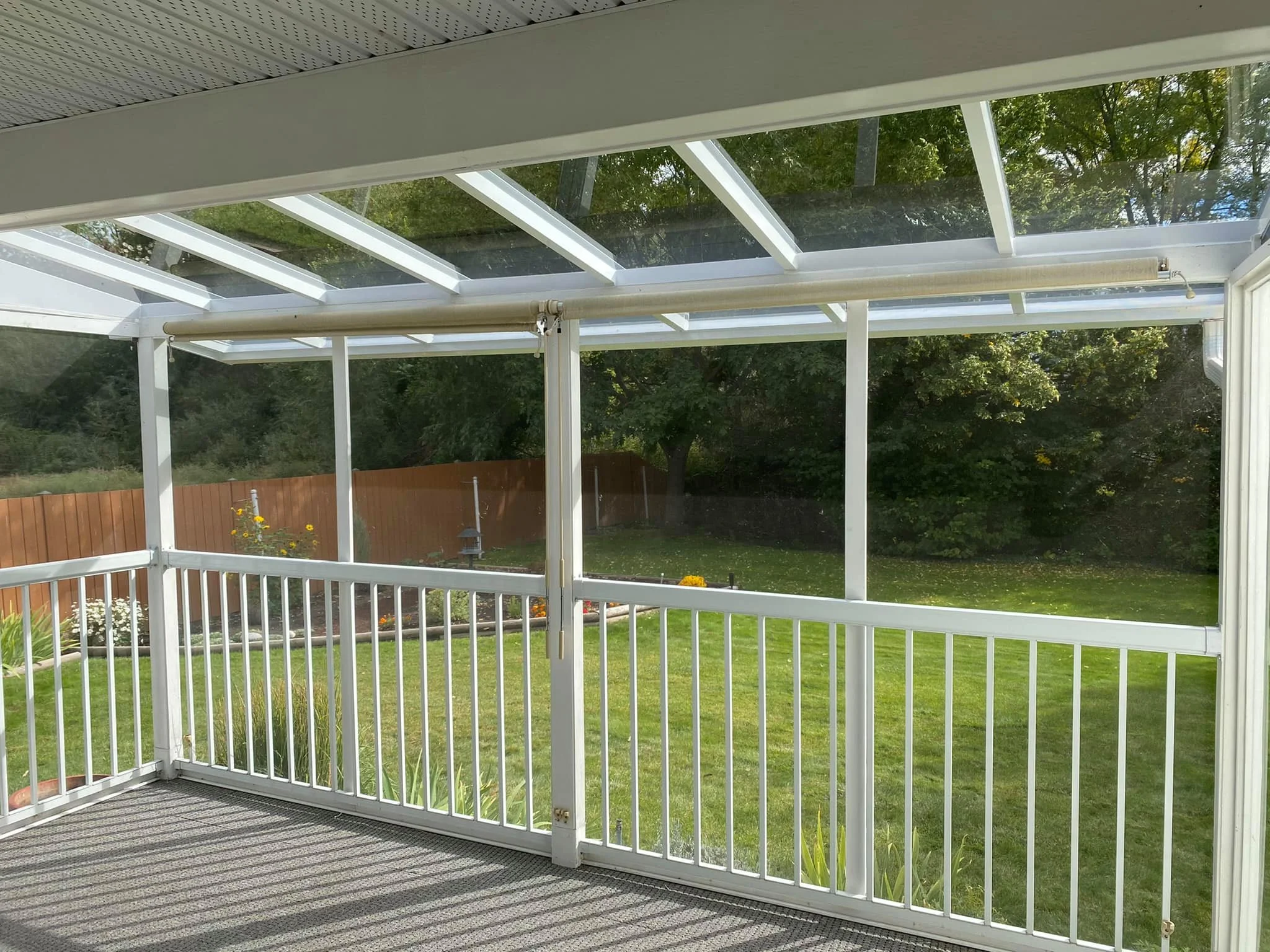
Sunroom Cost in BC (2026 Guide): Prices, Materials & What to Expect
Planning a sunroom in BC? The average 3-season sunroom costs between $10,000 and $30,000, while a fully insulated 4-season room runs $25,000 to $80,000+. I’ve built dozens of these across the Okanagan over the past decade, and I’ll walk you through exactly what drives these costs and where your money actually goes.
Average Sunroom Costs in BC (2026 Pricing)
Here’s what you can expect to pay for a sunroom in British Columbia this year, based on current material and labor costs:
| Sunroom Type | Size Range | Price Range | Cost Per Sq Ft |
|---|---|---|---|
| 3-Season (Basic) | 100-200 sq ft | $10,000 – $18,000 | $100 – $125 |
| 3-Season (Premium) | 200-300 sq ft | $18,000 – $30,000 | $125 – $150 |
| 4-Season (Entry) | 150-250 sq ft | $25,000 – $45,000 | $150 – $200 |
| 4-Season (High-End) | 250-400 sq ft | $45,000 – $80,000+ | $180 – $250+ |
These prices include materials, labor, permits, and a basic foundation (either deck-mounted or concrete pad). They do not include electrical work, plumbing, or HVAC extensions—those are add-ons we’ll cover later.
3-Season vs 4-Season: What Drives the Cost Difference?
The jump from a 3-season to a 4-season sunroom isn’t just about insulation. Here’s what you’re actually paying for:
3-Season Sunrooms ($10K-$30K)
- Single-pane or basic insulated glass (not thermal-rated for winter)
- Minimal wall insulation (often just R-4 to R-8)
- No dedicated heating/cooling (relies on ambient temperature)
- Simpler foundation requirements (can often use existing deck)
- Usable 8-9 months per year (March through November in most of BC)
We build a lot of these in the Okanagan because our climate is perfect for them. You get protection from wind, rain, and bugs, plus you can use the space well into October without any heating. The cost savings versus a 4-season room let most clients upgrade to a larger footprint instead.
4-Season Sunrooms ($25K-$80K+)
- Dual or triple-pane low-E glass (argon-filled for insulation)
- Full wall insulation (R-20 to R-30 in walls, R-40+ in roof)
- Insulated foundation (frost-protected or full basement tie-in)
- Dedicated HVAC extension (baseboard heaters or forced air hookup)
- Year-round comfort (maintains 18-22°C even in January)
- Building code compliance as living space (treated as a room addition, not a seasonal structure)
The HVAC piece alone can add $3,000-$8,000 to your project. If you’re extending central heating, you need ducting, possibly an upgraded furnace, and definitely a permit. Baseboard heaters are cheaper upfront but cost more to run long-term.
Cost Per Square Foot: BC Regional Variations
Sunroom costs vary across BC based on labor rates, material shipping, and local permit fees. Here’s what we see in 2026:
| Region | 3-Season ($/sq ft) | 4-Season ($/sq ft) | Notes |
|---|---|---|---|
| Metro Vancouver | $180 – $250 | $230 – $320 | Highest labor costs, strict permitting |
| Victoria & Island | $160 – $220 | $210 – $280 | Milder climate = lighter insulation needs |
| Okanagan Valley | $150 – $210 | $200 – $260 | Sweet spot for 3-season builds |
| Interior (Kamloops, Prince George) | $140 – $190 | $190 – $240 | Lower labor, but harsher winters = heavier snow loads |
| Kootenays | $135 – $180 | $180 – $230 | Remote areas add material shipping costs |
These are 2026 averages for professionally installed sunrooms with quality materials. DIY kits can knock 40-60% off these numbers, but you’re trading your time and assuming all the risk if something goes wrong.
Why Okanagan Pricing is Competitive
We’re in a good spot here in the valley. Local manufacturing means we don’t pay Vancouver shipping premiums, and the labor market is competitive without being cutthroat. Plus, our climate is ideal for 3-season builds—you don’t need the extreme snow load engineering required up north or the hurricane-grade wind resistance needed on the coast.
Key Cost Factors (8 Variables That Impact Your Price)
Every sunroom quote varies based on these factors. Understanding them helps you spot where costs come from and where you can make strategic trade-offs.
1. Size & Configuration
Square footage is the biggest driver, but layout matters too. A simple rectangle is cheaper than an L-shape or octagon. Every corner adds framing complexity, and curved walls require custom glass cutting.
- 100-150 sq ft: $10K-$20K (small breakfast nook size)
- 150-250 sq ft: $18K-$35K (most common, fits a seating area + small dining table)
- 250-400 sq ft: $35K-$60K (full entertaining space with multiple zones)
- 400+ sq ft: $60K-$100K+ (basically a whole room addition)
2. Glass Type & Glazing
Glass is where you’ll feel the budget impact immediately. It’s also where most people try to save money and then regret it two winters later.
- Single-pane: $15-$25/sq ft (never recommended in BC—you’ll freeze in October)
- Double-pane insulated: $35-$55/sq ft (minimum for 3-season use)
- Low-E argon-filled: $50-$75/sq ft (4-season standard, blocks UV and heat loss)
- Triple-pane: $80-$120/sq ft (overkill unless you’re at altitude or in the Interior)
3. Foundation Type
This is the least sexy part of the project but one of the most important. A bad foundation will haunt you forever.
- Deck-mounted: $800-$2,000 (uses existing deck structure, only works for 3-season)
- Concrete pad (4″ slab): $2,500-$5,000 (most common, requires gravel base and rebar)
- Frost-protected foundation: $4,000-$8,000 (required for 4-season in most of BC, digs below frost line)
- Full basement tie-in: $6,000-$12,000 (if you’re adding a crawlspace or full basement under the sunroom)
In the Okanagan, frost depth is 18-24 inches depending on elevation. Vernon and higher elevations need deeper footings than Osoyoos. Don’t skip this step—frost heave will crack your walls and break glass seals within two years.
4. Roof Style & Material
Roof choice affects both cost and aesthetics. More importantly, it affects how much snow you can handle and whether you cook in the summer sun.
- Gable roof (shingled): $3,000-$6,000 (traditional, matches house, best snow shedding)
- Studio roof (low-pitch shingled): $2,500-$5,000 (modern look, cheaper, needs more insulation)
- Glass or polycarbonate roof panels: $4,000-$8,000 (maximum light, needs tinting or you’ll roast)
- Insulated aluminum panels: $5,000-$9,000 (best thermal performance, blocks summer heat)
We mostly build gable roofs here because snow is real. I’ve seen polycarbonate roofs sag under 3 feet of wet March snow. If you want a glass roof, you need engineered snow load calculations and probably a steeper pitch than you’re picturing.
5. HVAC & Climate Control
This is where 4-season costs explode. You’re not just buying a heater—you’re integrating into your home’s systems.
- No climate control: $0 (3-season only, relies on ambient temp)
- Portable space heater: $100-$300 (DIY solution, not permitted for permanent install)
- Electric baseboard heaters: $800-$2,000 installed (cheapest permanent option, higher operating cost)
- Mini-split heat pump: $3,000-$5,000 (both heating and AC, energy-efficient, doesn’t require ductwork)
- Forced air extension: $4,000-$8,000 (ties into central HVAC, may require furnace upgrade)
For most Okanagan homeowners, a mini-split is the best call. You get AC for those 38°C July afternoons and efficient heating down to -15°C without tearing into your existing ductwork.
6. Finishes & Interior Upgrades
Once the shell is done, you’re choosing how nice you want the inside to look.
- Basic: Painted drywall, vinyl flooring, builder-grade trim ($2,000-$4,000)
- Mid-range: Textured walls, laminate or engineered hardwood, upgraded trim ($4,000-$7,000)
- High-end: Custom millwork, tile or real hardwood, ceiling features ($7,000-$15,000+)
Don’t forget lighting and electrical. Budget $1,000-$2,500 for basic lighting, outlets, and switches. If you want potlights, dimmers, or ceiling fans, add another $800-$1,500.
7. Permits & Engineering
You can’t escape this in BC. Any structure over 10 m² (107 sq ft) requires a building permit. Learn more in our BC patio cover permit guide.
- Building permit: $600-$1,500 (depends on municipality and project value)
- Structural engineering (if required): $1,500-$3,500 (usually needed for 4-season or large spans)
- Electrical permit: $150-$400 (if adding circuits or subpanel)
- Plumbing permit: $200-$500 (if adding a wet bar or sink)
West Kelowna and Kelowna have relatively streamlined permit processes. Expect 4-6 weeks for approval if your plans are complete. Rural areas like Lake Country can be faster but may have stricter setback requirements.
8. Site Conditions & Access
This is the wildcard that can blow up a quote.
- Flat, accessible yard with good drainage: No extra cost
- Sloped lot requiring retaining wall or fill: $2,000-$8,000
- Poor soil (clay or rock) needing excavation or drainage: $1,500-$5,000
- Difficult access (narrow gates, no crane access): $500-$2,000 in extra labor
- Existing deck removal or relocation: $1,000-$4,000
If you’re on a hillside in West Kelowna with a view of the lake, you’re probably dealing with at least one of these. Budget 10-15% extra for unknowns.
Material Choices: Frame, Glass & Roofing
Let’s break down the three major material categories and what you’re actually getting at each price point.
Frame Materials
Vinyl ($25-$45/linear foot): Cheapest option, zero maintenance, good insulation, but limited color choices and can look cheap. Works fine for basic 3-season builds where aesthetics aren’t the priority. Expands and contracts in extreme temps—not ideal above 1,200m elevation.
Aluminum ($35-$60/linear foot): My go-to for most projects. Powder-coated aluminum doesn’t rust, handles snow loads beautifully, and comes in dozens of colors. Slightly worse thermal performance than vinyl, but you can fix that with thermal breaks in 4-season builds. We use this for 90% of our 3-season room builds in the Okanagan.
Wood ($50-$85/linear foot): Beautiful, traditional, and high-maintenance. Cedar or fir frames need staining every 3-5 years in BC’s climate. They also cost 50-100% more than aluminum. I only recommend wood if you’re matching a heritage home or have strong aesthetic preferences and the budget to maintain it.
Engineered Composites ($60-$95/linear foot): New option combining wood fiber and polymer. Looks like wood, performs like vinyl. Great middle ground, but limited availability in BC and higher cost than aluminum without a clear performance advantage.
Glass Options
Glass typically accounts for 30-40% of your total sunroom cost, so this is where material choice really matters.
Tempered vs Laminated: Tempered glass (standard) shatters into small cubes if broken—safe but the whole panel needs replacement. Laminated glass (like car windshields) cracks but stays intact. It’s 20-30% more expensive but worth it if you have kids or the sunroom faces a play area.
Tinting & Coatings: Bronze or gray tint adds $8-$15/sq ft but cuts glare and heat gain by 40-60%. Low-E coating adds $12-$20/sq ft but reduces winter heat loss by 30-50%. In the Okanagan, I recommend tint on south and west exposures, low-E on north and east.
Size Matters: Standard glass panels (up to 60″ x 80″) cost 20-30% less than custom sizes. If your design allows it, stick to stock dimensions. Custom curved or angled glass can double your glass budget.
Roofing Materials
Asphalt Shingles ($3-$6/sq ft installed): Most common, matches your house, 20-30 year lifespan. Choose architectural shingles over 3-tab—they look better and handle wind uplift better.
Metal Roofing ($8-$14/sq ft installed): Lasts 40+ years, sheds snow instantly, reflects summer heat. Loud in heavy rain unless you add sound-deadening insulation underneath. Popular in the Interior where snow is heavy.
Polycarbonate Panels ($6-$12/sq ft installed): Lightweight, lets in diffused light, cheaper than glass. Yellows after 10-15 years and scratches easily. Only use if maximum light is the priority and you’re okay with replacing panels in 15 years.
Insulated Aluminum Panels ($10-$18/sq ft installed): Best thermal performance, no maintenance, but blocks all light. Good for 4-season rooms where you’re adding skylights or clerestory windows anyway.
BC Building Codes & Permit Requirements
BC Building Code treats sunrooms differently depending on whether they’re 3-season or 4-season, and municipalities add their own requirements on top.
When You Need a Permit
In BC, you need a building permit for any sunroom over 10 m² (107 sq ft). Most sunrooms fall well above this threshold, so plan on permitting from day one.
- 3-season sunrooms: Classified as “accessory structures” in most municipalities. Simpler permit process, less stringent energy code requirements.
- 4-season sunrooms: Treated as habitable space additions. Full energy code compliance (insulation, HVAC, ventilation), often require structural engineering stamps.
Typical Permit Costs in Okanagan Municipalities
| Municipality | Permit Fee | Timeline | Notes |
|---|---|---|---|
| Kelowna | $800 – $1,400 | 4-6 weeks | Strict zoning, may require variance for setbacks |
| West Kelowna | $600 – $1,100 | 3-5 weeks | Streamlined process, good online resources |
| Vernon | $650 – $1,200 | 4-6 weeks | Energy advisor review required for 4-season |
| Penticton | $700 – $1,300 | 4-7 weeks | Heritage area restrictions near downtown |
| Lake Country | $550 – $1,000 | 3-5 weeks | Faster rural processing, stricter fire access |
What Inspectors Look For
You’ll typically get 2-3 inspections during construction:
- Foundation inspection: Before pouring concrete or closing in footings. They check depth, rebar placement, and drainage.
- Framing inspection: After framing is up but before insulation. Verifying structural connections, joist spacing, and snow load compliance.
- Final inspection: Everything complete. They check electrical, insulation R-values, glazing labels, egress windows (if 4-season), and overall workmanship.
Labor Costs: DIY Kits vs Professional Installation
Labor typically represents 40-60% of your total sunroom cost. Here’s what you’re paying for and whether you can realistically DIY it.
Professional Installation ($8,000-$35,000)
For a typical 200 sq ft sunroom, professional installation breaks down like this:
- Site prep & foundation: $2,000-$5,000 (excavation, formwork, concrete pour, grading)
- Framing & structural: $2,500-$6,000 (wall framing, roof trusses, attachment to house)
- Glazing installation: $1,500-$4,000 (measuring, cutting, sealing all glass panels)
- Roofing & weatherproofing: $1,200-$3,500 (shingles, flashing, gutters)
- Interior finishes: $1,500-$4,000 (drywall, flooring, trim, paint)
- Electrical & HVAC: $1,500-$8,000 (depends on scope)
- Cleanup & final touches: $500-$1,500
You’re also paying for permits, insurance, warranty, and the guarantee that it’s done right. A good contractor carries $2M+ liability insurance and offers a 2-5 year workmanship warranty on top of manufacturer warranties.
DIY Kits ($8,000-$25,000 materials only)
Prefab sunroom kits promise 50-60% savings but come with major trade-offs:
What’s Included:
- Pre-cut aluminum or vinyl frame components
- Glass or polycarbonate panels (sometimes)
- Roofing panels or shingle package
- Hardware, fasteners, and basic instructions
What’s NOT Included:
- Foundation (you need to pour this separately)
- Electrical or HVAC (hire licensed trades)
- Permits and engineering (your responsibility)
- Tools (you’ll need a chop saw, drill, level, and probably a friend with a truck)
- Expertise (if you mess up flashing or glass seals, leaks are your problem)
Realistic DIY Timeline: Plan on 3-6 weekends for a 150-200 sq ft sunroom if you’re handy and have help. That doesn’t include foundation work or finishing. Most DIYers I’ve talked to underestimate by 50-100%.
Hybrid Approach: GC + Specialty Trades
Some homeowners act as their own general contractor, hiring trades for specific pieces:
- Foundation company: $3,000-$6,000
- Framing contractor: $4,000-$8,000
- You install kit components: (your time)
- Licensed electrician: $1,200-$2,500
- HVAC tech: $2,000-$4,000
This can save 20-30% versus full turnkey, but you’re coordinating schedules, managing inspections, and assuming liability. It works if you’re organized and have flexibility to troubleshoot when the framer is delayed or the kit arrives with missing parts.
Hidden Costs & Budget Padding
Every sunroom project has surprise costs. Here are the ones that catch people off guard.
Engineering & Design Fees ($1,500-$5,000)
If you’re building a 4-season sunroom over 250 sq ft, or if you’re on a sloped lot, most municipalities require a stamped structural engineering letter. This isn’t the building permit—it’s a separate professional fee to prove your design meets snow load, wind load, and seismic requirements.
Utility Upgrades ($800-$4,000)
Adding a sunroom often means:
- Electrical panel upgrade: If your panel is full, adding circuits for heating, lighting, and outlets requires a subpanel or full panel swap ($1,500-$3,500)
- HVAC capacity check: Your furnace may need upgrading to handle the extra square footage ($0 if you’re within capacity, $3,000-$8,000 if you need a bigger unit)
- Drainage extensions: Gutters, downspouts, and drainage away from the foundation ($300-$1,200)
Landscaping & Hardscaping ($1,000-$5,000)
After construction, your yard is a mess. Budget for:
- Grading and topsoil replacement
- New sod or landscaping around the foundation
- Pathways or patio extensions to integrate the sunroom with your yard
- Possibly a deck rebuild if the sunroom replaced part of your existing deck
Furniture & Finishing Touches ($2,000-$8,000+)
You’ve spent $30K on the room—now you need to furnish it. Outdoor-rated furniture that can handle temperature swings in a 3-season room costs more than indoor stuff. Budget for seating, tables, rugs, and window treatments (blinds or shades to control glare).
Contingency (15-20% of Total Budget)
Here’s the truth: almost no sunroom project comes in exactly on budget. You’ll find rot in the rim joist when you attach the ledger. The electrician discovers knob-and-tube wiring. The concrete pour costs more because you hit rock 6 inches down.
If your base quote is $25,000, budget $29,000-$30,000. If you don’t need the contingency, great—buy nicer furniture. But you’ll probably need it.
Return on Investment
Sunrooms don’t recoup their full cost at resale, but they add value and marketability. Here’s what the numbers look like in BC’s real estate market as of 2026.
3-Season Sunroom ROI
Average Cost: $20,000
Added Home Value: $8,000-$12,000 (20-40% ROI)
Time to Sell Impact: Homes with sunrooms sell 10-15% faster in shoulder seasons (spring/fall)
The financial ROI is weak, but the lifestyle ROI is huge. Most clients tell me they use their sunroom 5-7 months per year and it becomes their favorite space in the house. That’s worth more than a spreadsheet shows.
4-Season Sunroom ROI
Average Cost: $40,000
Added Home Value: $20,000-$28,000 (50-70% ROI)
Square Footage Impact: Counts as finished living space in appraisals
4-season rooms perform better because they’re essentially room additions. In Kelowna’s market, every finished square foot adds roughly $200-$300 to your home’s value. A 250 sq ft 4-season sunroom adds 250 sq ft of living space, which can translate to $50,000-$75,000 in perceived value on a million-dollar home.
Read more about how outdoor improvements affect property values in our BC home value impact guide.
Best ROI Scenarios
You’ll see better-than-average returns if:
- Your home is in a high-demand neighborhood (Kelowna’s Lower Mission, West Kelowna’s Lakeview Heights)
- The sunroom opens to a view (lake, mountain, vineyard)
- You’re adding square footage to a smaller home (under 1,800 sq ft) where every sq ft matters more
- The sunroom fixes a layout problem (connects kitchen to backyard, replaces a useless side yard)
Worst ROI Scenarios
You’ll struggle to recoup costs if:
- You over-improve for your neighborhood (a $60K sunroom on a $450K starter home)
- The sunroom blocks natural light to main living areas
- You cheap out on finishes and it looks like an afterthought add-on
- It’s poorly integrated with the home’s architecture (modern glass box on a heritage farmhouse)
Financing Options for BC Homeowners
Most sunrooms cost more than people have sitting in savings. Here’s how clients typically pay for these projects in 2026.
Home Equity Line of Credit (HELOC)
Current Rates: Prime + 0.5% to 2% (roughly 7-9% as of March 2026)
Pros: Low rates, flexible repayment, interest-only payments available, no early repayment penalty
Cons: Requires home equity (at least 20%), variable rates can rise
This is the most common option for Okanagan homeowners. If you bought your home before 2021, you likely have enough equity to borrow $30K-$50K without breaking a sweat.
Home Equity Loan (Fixed)
Current Rates: 6.5-8.5% fixed
Pros: Fixed monthly payment, rate locked in, predictable budgeting
Cons: Less flexible than HELOC, higher rates than variable
Makes sense if you want payment certainty and plan to pay it off over 5-10 years. Good for 4-season builds where you’re treating it like a true room addition.
Personal Loan or Line of Credit
Current Rates: 9-14% depending on credit
Pros: No home equity required, faster approval
Cons: Higher rates, shorter terms (5 years max typically)
Only use this if you don’t have home equity or you’re planning to sell within 2-3 years anyway.
Contractor Financing
Some contractors offer financing through partners like Financeit or Fairstone. Be careful. Rates are often 12-20% APR, and the “no payments for 12 months” deals convert to massive interest charges if you don’t pay off the balance in time.
If you’re using contractor financing, read the terms carefully and have a plan to pay it off before the promotional period ends.
Cash-Out Refinance
If you’re refinancing your mortgage anyway, rolling a sunroom into your new mortgage can get you rates around 5-6.5% amortized over 25-30 years. This only makes sense if:
- You’re already planning to refinance
- Your current mortgage rate is higher than current rates
- You can stomach extending your amortization and paying interest for decades on a sunroom
Most financial advisors say don’t do this unless the numbers really work.
How to Get Accurate Quotes in the Okanagan
Getting a solid quote requires doing your homework upfront. Here’s how to approach contractors so you’re comparing apples to apples.
Before You Call Anyone
- Measure your space: Know the dimensions (length, width, height of attachment point on house)
- Decide on type: 3-season or 4-season (this changes everything)
- Set a budget range: Be honest about what you can spend—it saves everyone time
- Check your property: Know your setbacks, lot lines, and any HOA or strata restrictions
Questions to Ask During Quotes
- “What’s included in this price?” (Get it in writing—foundation, permits, HVAC, electrical, finishes)
- “What’s your timeline from contract to completion?” (4-8 weeks is typical for a 200 sq ft build)
- “Who’s doing the work?” (In-house crew vs subcontractors)
- “What warranties do you offer?” (Workmanship: 2-5 years, materials: 10-30 years depending on component)
- “Have you done sunrooms in my municipality before?” (Permitting experience matters)
- “Can I see a similar completed project?” (Photos or ideally a site visit)
- “What happens if we hit rock or find rot during construction?” (Change order process and rates)
Red Flags to Watch For
- Cash-only pricing: If they offer a discount for cash, they’re probably not paying taxes and definitely not insured properly
- No written contract: Never, ever start work without a detailed contract
- Huge deposit upfront: 10-25% deposit is normal, 50%+ is a red flag
- No permit mention: If they don’t bring up permits, they’re either ignorant or planning to skip them (both bad)
- Pressure tactics: “This price is only good if you sign today” is a sales gimmick
- No insurance proof: Ask for a certificate of liability insurance (minimum $2M)
Getting 3 Quotes
Industry standard is to get 3 quotes. Here’s how to evaluate them:
- Quote 1 (Low): Often missing items or using cheaper materials. Ask what’s different.
- Quote 2 (Middle): Usually the most realistic. Compare scope line by line.
- Quote 3 (High): May include premium finishes or over-engineering. Decide if the extras are worth it.
Don’t automatically pick the cheapest. I’ve seen $15K quotes turn into $28K projects after all the “extras” get added. A $25K all-in quote is better than a $22K quote that doesn’t include foundation, permits, or electrical.
Frequently Asked Questions
How much does a sunroom cost in Canada?
In Canada, 3-season sunrooms typically cost $10,000-$30,000, while 4-season sunrooms range from $25,000-$80,000+ depending on size, materials, and location. Metro areas like Vancouver and Toronto see higher costs ($180-$320/sq ft) compared to smaller markets like the Okanagan ($150-$260/sq ft). The biggest cost drivers are glass type, foundation requirements, and whether you’re adding HVAC for year-round use.
Is a sunroom worth the investment?
It depends on your goals. If you’re looking for pure financial ROI, sunrooms return 20-70% of their cost at resale depending on type. But the lifestyle value is significant—you gain usable outdoor living space 8-12 months per year, which many homeowners say becomes their favorite room. 4-season sunrooms add finished square footage to your home’s appraisal, while 3-season rooms improve marketability without major value gains.
How much does a sunroom add to home value?
A 3-season sunroom typically adds $8,000-$12,000 in resale value (20-40% ROI), while a 4-season sunroom adds $20,000-$28,000 (50-70% ROI) because it counts as finished living space. In BC’s hot markets like Kelowna or Victoria, finished square footage adds roughly $200-$300 per sq ft to home values, so a 250 sq ft 4-season room can contribute $50,000-$75,000 in perceived value on higher-end properties.
Can you use a sunroom in winter?
Yes, but it depends on the type. A 3-season sunroom is usable in mild winter conditions (above 5°C) but won’t be comfortable during January cold snaps without supplemental heating. A 4-season sunroom with proper insulation (R-20 walls, low-E glass), a sealed foundation, and dedicated heating can maintain 18-22°C year-round even in -20°C weather. In the Okanagan, 3-season rooms are typically usable March through November, while 4-season rooms work 12 months.
Do I need a permit for a sunroom in BC?
Yes. In BC, any sunroom over 10 m² (107 sq ft) requires a building permit. Most municipalities also require separate electrical permits if you’re adding circuits, and plumbing permits if you’re installing a sink or wet bar. Permit costs range from $600-$1,500 depending on your municipality and project scope. 4-season sunrooms need full energy code compliance and often require stamped engineering drawings. Expect 3-7 weeks for permit approval in most Okanagan municipalities. See our full BC permit guide for details.
What is the cheapest type of sunroom?
The cheapest option is a basic 3-season sunroom with a vinyl frame, double-pane glass, a deck-mounted foundation, and a shingled gable roof. For a 100-150 sq ft build, you can get this done for $10,000-$15,000 professionally installed. DIY kits can cut this to $8,000-$12,000 in materials, but you’ll need construction skills and time. Avoid single-pane glass even though it’s cheaper—it’s unusable below 10°C and you’ll regret it every October.
How much does a 4-season sunroom cost vs 3-season?
A 4-season sunroom costs 2-3x more than a 3-season. For a 200 sq ft build: a 3-season room runs $18,000-$30,000, while a 4-season room costs $35,000-$60,000. The extra cost comes from upgraded insulation (R-20+ vs R-4), low-E argon-filled glass (vs basic double-pane), a frost-protected foundation, and HVAC integration ($3,000-$8,000 alone). You also pay more in permits and engineering since 4-season rooms are treated as habitable space additions under BC Building Code.
What is the cost per square foot for a sunroom in BC?
In BC, 3-season sunrooms cost $100-$210/sq ft depending on materials and region, while 4-season sunrooms run $150-$320/sq ft. Metro Vancouver is most expensive ($180-$320/sq ft), the Okanagan falls mid-range ($150-$260/sq ft), and the Interior is cheapest ($135-$240/sq ft) though snow load requirements can add costs. These prices include materials, labor, permits, and a basic foundation. Add 15-20% for sloped lots, difficult access, or premium finishes.
Can I install a sunroom myself to save money?
You can install a prefab sunroom kit yourself if you have construction experience, the right tools, and 3-6 weekends to spare. DIY kits cost $8,000-$25,000 in materials (50-60% savings on labor), but you’re responsible for foundation work, permits, electrical, and HVAC—which require licensed trades in BC. Most DIYers underestimate time by 50-100% and face challenges with glass sealing, flashing, and code compliance. I recommend DIY only for basic 3-season builds; 4-season rooms are too complex for most homeowners.
How long does it take to build a sunroom?
Professional sunroom installation takes 2-6 weeks from permit approval to completion. A basic 150 sq ft 3-season room can be done in 2-3 weeks, while a complex 300 sq ft 4-season room with HVAC integration takes 4-6 weeks. Add 3-7 weeks upfront for permit approval in most BC municipalities. Weather delays (rain, snow) can add 1-2 weeks during shoulder seasons. DIY builds take 4-8 weeks of weekend work for most homeowners, plus permit time.
Are there financing options for sunroom projects in Canada?
Yes, most homeowners finance sunrooms through a Home Equity Line of Credit (HELOC) at 7-9% interest, or a fixed home equity loan at 6.5-8.5%. Personal loans are available at 9-14% if you don’t have home equity. Some contractors offer financing through partners like Financeit, but rates are often 12-20% APR—read terms carefully to avoid deferred interest traps. Cash-out refinancing can get you mortgage rates (5-6.5%) but extends your amortization, which isn’t ideal for a $30K project unless you’re already refinancing.
What are the hidden costs of building a sunroom?
Hidden costs include structural engineering ($1,500-$3,500 for stamped drawings), electrical panel upgrades if your panel is full ($1,500-$3,500), HVAC capacity upgrades ($0-$8,000), landscaping restoration after construction ($1,000-$5,000), furniture and window treatments ($2,000-$8,000), and drainage extensions ($300-$1,200). Site surprises like rot in rim joists, rock excavation, or knob-and-tube wiring add unplanned costs. Always budget a 15-20% contingency on top of your contractor’s quote to cover unknowns.
Ready to Add a Sunroom to Your Okanagan Home?
We’ll walk you through the options, show you real pricing, and help you design a sunroom that fits your budget and lifestyle. Free quotes, no pressure.
Get Your Free Quote
Ready to Start Your Project?
Get a free, no-pressure quote. We’ll help you choose the right solution for your backyard.
Serving Kelowna, West Kelowna, Vernon, Penticton, Lake Country & Salmon Arm