

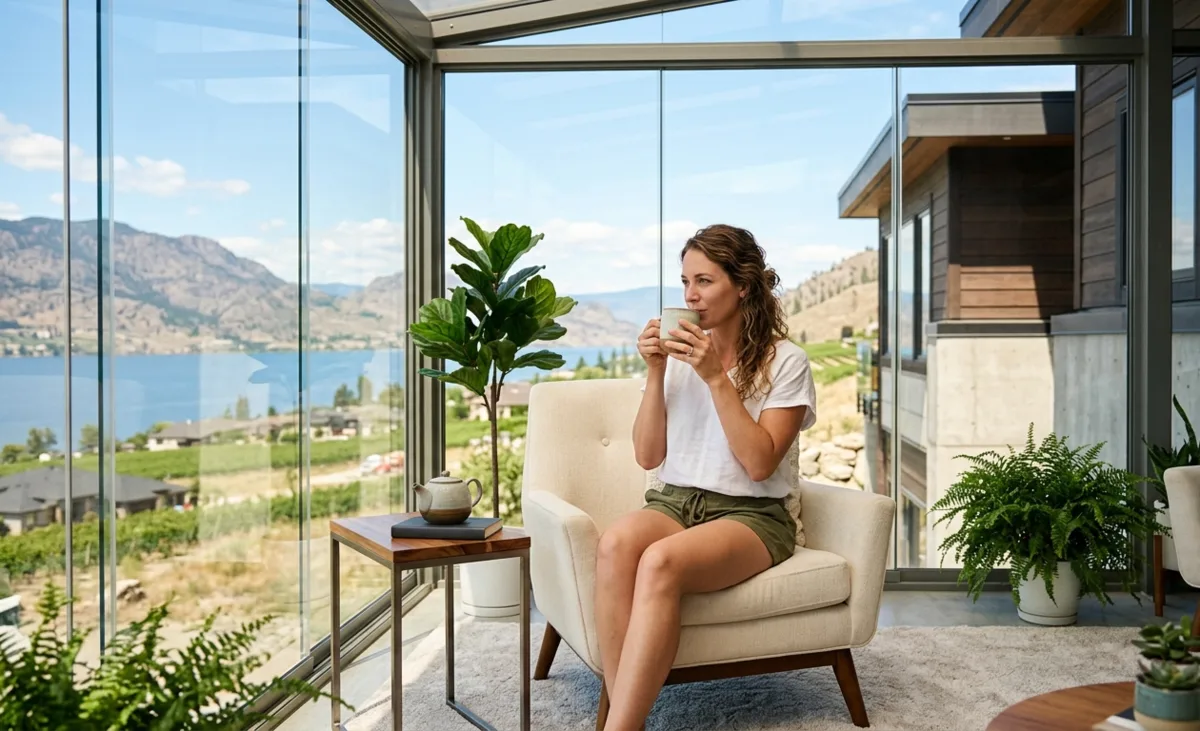
4-Season Sunrooms in the Okanagan: Designs, Heating & Year-Round Living
A 4-season sunroom gives you what a patio cover or 3-season room can’t: year-round living space. With proper insulation, climate control, and double or triple-pane windows, you can use this room in January just as comfortably as July. For Okanagan homeowners who want to enjoy natural light and views without being at the mercy of winter temperatures, a 4-season sunroom is the ultimate outdoor living upgrade.
Enjoy the outdoors year-round — even when it’s snowing outside.
What Is a 4-Season Sunroom?
A 4-season sunroom (also called an all-season room or year-round sunroom) is a fully insulated, climate-controlled room addition with large windows that maximize natural light. Unlike screened porches or 3-season rooms, 4-season sunrooms have:
- Insulated walls, roof, and floor
- Double or triple-pane windows
- Heating and cooling systems
- Electrical and lighting
The result is a room you can use comfortably in any weather — enjoying morning coffee during a snowstorm or reading in natural light on a -20°C day.
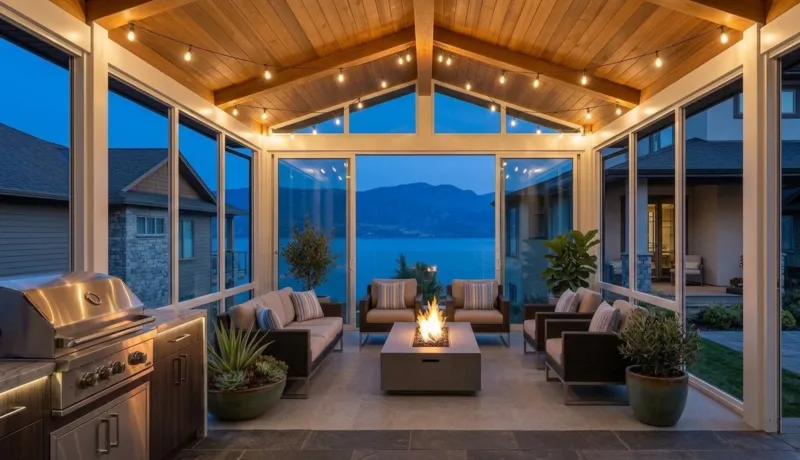
3-Season vs 4-Season Sunrooms
Understanding the difference helps you choose the right investment for your needs:
| Feature | 3-Season Sunroom | 4-Season Sunroom |
|---|---|---|
| Usable Months | Spring, Summer, Fall (6-8 months) | All 12 months |
| Insulation | Minimal or none | Fully insulated (walls, roof, floor) |
| Windows | Single pane or screens | Double or triple pane, Low-E |
| Heating/Cooling | None or portable | Integrated HVAC system |
| Foundation | Often on deck or simple piers | Insulated slab or crawl space |
| Electrical | Basic lighting | Full electrical, outlets, lighting |
| Permit Requirements | Usually required | Always required (room addition) |
| Relative Investment | Lower | Higher (heated, insulated build) |
| Home Value Impact | Moderate | Significant (adds heated square footage) |
When to Choose 3-Season
- Budget is primary concern
- You’ll primarily use the space in warm months
- You don’t need climate control
- You want enhanced outdoor living, not indoor space
When to Choose 4-Season
- You want year-round use regardless of weather
- You need additional heated living space
- You want maximum home value increase
- You’re extending bedrooms, offices, or living areas
5 Benefits of 4-Season Sunrooms
Year-Round Use
The defining benefit: use your sunroom in any season. Enjoy natural light and views during Okanagan winters without bundling up. Host gatherings in December. Work from home surrounded by windows when it’s snowing outside.
Added Living Space
A 4-season sunroom adds genuine square footage to your home — not just covered outdoor area. Use it as home office, dining room extension, reading nook, guest bedroom, yoga room, or indoor garden.
Natural Light
Large window areas flood the space with daylight. Natural light improves mood, sleep quality, and productivity. In Okanagan winters, a sunroom can be the brightest room in your home.
Energy Efficiency
Modern 4-season sunrooms use high-performance windows and insulation that meet or exceed building code. Low-E glass reduces heat loss while letting light through. Can contribute passive solar heating to your home.
Property Value
A 4-season sunroom adds genuine heated, conditioned square footage that counts in appraisals — making it one of the more valuable home improvements you can make. Real living space you use every day, not just covered outdoor area.
4-Season Sunroom Design Options
Roof Styles
Studio (Flat/Shed): Single-slope roof that attaches to house at the high end. Most economical option, works well for contemporary homes.
Gable: Peaked roof that creates height and drama. Can match your home’s existing roofline. More expensive than studio style.
Cathedral: High vaulted ceiling with exposed beams. Maximum sense of space. Works with larger sunrooms.
Conservatory: Multi-faceted or curved glass roof sections. Historic or Victorian aesthetic. Most expensive option.
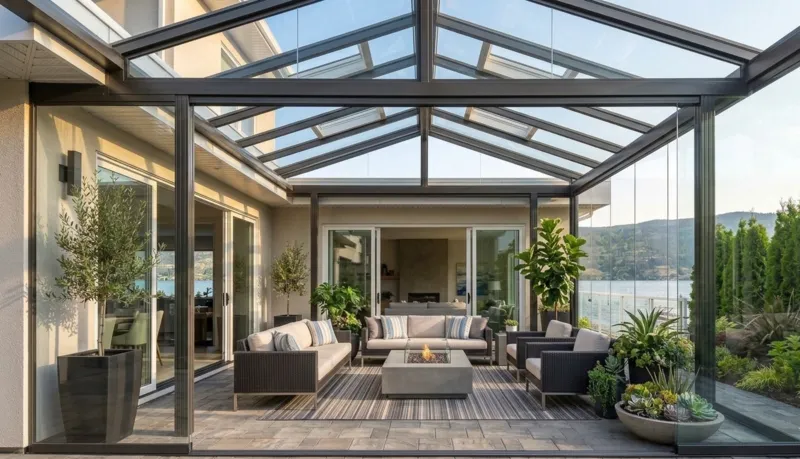
Window Options
Double-pane Low-E: Standard for 4-season rooms. Two glass layers with argon gas fill and low-emissivity coating. Good thermal performance at moderate cost.
Triple-pane: Three glass layers for maximum insulation. Recommended for extreme climates or northern exposure. A premium upgrade over double-pane that pays you back in lower heating bills.
Operable vs Fixed: Mix of windows that open (for ventilation) and fixed panels (maximum view, lower cost). Typical ratio: 40-60% operable.
Foundation Types
Concrete Slab: Poured concrete with insulation underneath. Most durable and provides thermal mass. Required for cold climate 4-season rooms.
Insulated Crawl Space: Floor system over insulated crawl space. Allows access to utilities. Works when slab isn’t practical.
On Existing Deck: Possible with structural upgrades, but not ideal for 4-season performance. Better to remove deck and install proper foundation.
Heating & Cooling Options
Climate control is what makes a sunroom usable year-round. Options include:
Ductless Mini-Split (Most Popular)
A dedicated heat pump provides both heating and cooling. Mounted high on the wall, it’s efficient, quiet, and doesn’t require extending your home’s ductwork.
Pros:
- Independent temperature control
- High efficiency (heat pump technology)
- Provides heating AND cooling
- No ductwork needed
Cons:
- Visible indoor unit
- Up-front cost of the unit and install
HVAC Extension
Extend your home’s existing heating and cooling system into the sunroom via new ductwork.
Pros:
- Same comfort as rest of home
- No visible equipment in room
- Uses existing thermostat/controls
Cons:
- Requires ductwork (construction cost)
- May overload existing system
- Less efficient if sunroom has different exposure
Radiant Floor Heating
Electric or hydronic heating elements installed under the floor. Provides even, comfortable heat.
Pros:
- Most comfortable heat distribution
- No visible equipment
- Works well with tile or concrete floors
Cons:
- Must be installed during construction
- Slower response time
- Higher installation cost
- Doesn’t provide cooling
Electric Baseboard
Wall-mounted electric heaters. Simple and economical to install.
Pros:
- Low installation cost
- Zone control possible
- No maintenance
Cons:
- Higher operating cost than heat pump
- Takes wall space
- Doesn’t provide cooling
What Goes Into Your Sunroom
Every 4-season sunroom is custom, so there’s no off-the-shelf price — it comes down to the size you want, the windows and roof style you choose, your foundation, and how you heat and cool the room. We design and manufacture in-house and install with our own West Kelowna crew, then give you one straight, no-pressure quote for the whole project.
What Affects Your Price
- Size: A larger footprint means a bigger overall project
- Windows: Double vs triple-pane, amount of glass
- Roof style: Studio is most economical; conservatory is most expensive
- Foundation: New slab vs existing structure
- HVAC: Mini-split is mid-range; extending existing HVAC varies widely
- Finishes: Flooring, ceiling, trim, electrical fixtures
Get Accurate Pricing
Every project is different. We’ll measure your property and provide a detailed, no-obligation estimate.
Request Free QuoteBuilding Permits & Code
4-season sunrooms always require building permits because they’re room additions. The permit process ensures:
Structural Requirements
- Foundation, framing, and roof meet code
- Connections to existing structure are safe
- Roof loads handled properly
Energy Code
- Insulation meets efficiency requirements
- Windows meet minimum U-factor
- HVAC sized appropriately
Safety & Setbacks
- Wiring meets current electrical code
- Room respects property line requirements
- Emergency egress requirements met
We keep it simple. Because a true 4-season room is an insulated addition, it does need a permit — we’ll tell you exactly what your project requires so there are no surprises. Timelines vary by municipality — typically 2-4 weeks in the Okanagan.
Inspections
Typical inspection stages:
Foundation/Footing Inspection
Before concrete pour
Framing Inspection
Structure and connections verified
Insulation/Vapor Barrier
Energy code compliance check
Electrical Rough-In
Wiring before drywall
Final Inspection
Occupancy approval
Frequently Asked Questions
What’s the difference between a 3-season and 4-season sunroom?
A 3-season sunroom lacks insulation and climate control — it’s comfortable in spring, summer, and fall but too cold in winter. A 4-season sunroom is fully insulated with double/triple-pane windows and a heating system, making it comfortable year-round.
How much does a 4-season sunroom cost?
Every 4-season sunroom is custom, so the price comes down to size, the windows and roof style you choose, your foundation, and how you heat and cool it. We measure your space and give you one straight, no-pressure quote — no surprises.
Can you convert a 3-season room to 4-season?
Sometimes, but it’s often more cost-effective to build correctly from the start. Converting means adding insulation, replacing windows with thermal units, adding heating, and often upgrading the foundation — so it usually costs nearly as much as building new.
Do 4-season sunrooms add home value?
Yes, significantly. Unlike a deck or patio cover, a 4-season sunroom adds conditioned, heated square footage that counts in appraisals — real living space that shows up in your home’s value.
What heating system is best for a 4-season sunroom?
Ductless mini-splits are most popular because they provide both heating and cooling, are highly efficient, and don’t require extending your home’s ductwork. They give you independent temperature control for the room.
Can you use a 4-season sunroom as a bedroom?
If the room meets building code requirements for a bedroom — including minimum size, window egress, and ceiling height — it can legally be used as a bedroom. This requires planning during design to ensure compliance.
How much insulation does a 4-season room need?
BC Building Code requires R-20 or better for walls and R-30+ for ceilings in heated spaces. Windows must meet minimum U-factor requirements. We design to meet or exceed these standards for comfortable year-round use.
Do 4-season sunrooms need permits?
Yes, always. A true 4-season room is an insulated addition with structural, electrical, and energy-code implications, so it needs a building permit in every Okanagan municipality. We’ll tell you exactly what your project requires and keep the process simple.
What windows are used in 4-season sunrooms?
Double-pane Low-E windows are standard. Triple-pane windows are recommended for northern exposures or maximum efficiency. Windows should have low U-factor (better insulation) and appropriate solar heat gain coefficient for the exposure.
How long does it take to build a 4-season sunroom?
Typical construction takes 4-8 weeks from permit approval. Design and permitting add 4-8 weeks before construction. Total timeline from first consultation to completion is usually 3-5 months.
Are 4-season sunrooms energy efficient?
Modern 4-season sunrooms are highly efficient when properly designed. High-performance windows, quality insulation, and efficient heating systems minimize energy use. Some rooms even provide passive solar gain that reduces home heating costs.
Can you build a 4-season sunroom on a deck?
Not typically. Decks lack the insulated foundation needed for year-round comfort. Converting a deck to a 4-season room usually requires removing the deck and installing a proper insulated slab or crawl space foundation.
Ready for Your Year-Round Sunroom?
A 4-season sunroom is one of the most satisfying home improvements — a bright, comfortable space you’ll use every day, regardless of what the Okanagan weather is doing outside. We design and build custom sunrooms that match your home’s architecture and your lifestyle needs.
Start Your Sunroom Project
Ready to Start Your Project?
Get a free, no-pressure quote. We’ll help you choose the right solution for your backyard.
Serving Kelowna, West Kelowna, Vernon, Penticton, Lake Country & Salmon Arm