

Deck Railing Materials Compared: 5 Options for BC Decks in 2026
Five materials. One deck. Pick the wrong one and you’re looking at years of maintenance headaches or a full replacement within a decade. This deck railing materials comparison breaks down the lifespans, maintenance, and trade-offs for BC homeowners. No vague “it depends” answers here.
BC homeowners deal with conditions that test every railing system on the market. Okanagan temperature swings from -15°C to 35°C+. Interior dry heat that cracks wood in a single summer. Lake-effect moisture near Okanagan and Kalamalka shorelines. Snow loads that stress every fastener and post bracket through winter. Sound familiar?
This guide puts glass, aluminum, cable, composite, and wood railings head-to-head with durability data, maintenance requirements, and BC building code compliance. We install glass and aluminum railings across the Okanagan, but we’ll tell you straight when cable, composite, or wood makes more sense for your situation. The right deck railing depends on your view, your budget, and how much time you want to spend with a stain brush every spring.
Quick Comparison: 5 Deck Railing Materials at a Glance
Before we dig into each material, here’s the full picture in one table, ranked on the factors that matter most for BC decks.
| Factor | Glass | Aluminum | Cable | Composite | Wood |
|---|---|---|---|---|---|
| Relative Upfront Cost | Premium | Mid-range value | Moderate | Budget-friendly | Lowest upfront |
| Lifespan | 25+ yrs | 20-30 yrs | 20-30 yrs | 25-30 yrs | 10-15 yrs |
| Maintenance | Quarterly rinse | Annual wash | Bi-annual tension check | Occasional wash | Annual stain/seal |
| View Clarity | Unobstructed | Partial (pickets) | Near-clear | Partial | Partial |
| DIY-Friendly | No | Yes (kits) | Moderate | Yes (kits) | Yes |
| BC Code Compliant | Yes | Yes | Yes (conditions) | Yes | Yes |
| Best For | Lake/mountain views | Budget + durability | Modern aesthetic | Matching composite deck | Budget, rustic look |
Climate performance varies by material. What holds up on a Kamloops hillside won’t necessarily perform the same in Vernon lake-effect moisture. Each section below covers Okanagan-specific climate notes so you know exactly what to expect.
Not Sure Which Material Fits Your Deck?
We design, build, and install glass and aluminum railings with our own West Kelowna crew. We’ll assess your deck, your view, and your budget, then give you an honest recommendation. No pressure.
Get a Free QuoteGlass Railings: Unbeatable Views, Premium Price
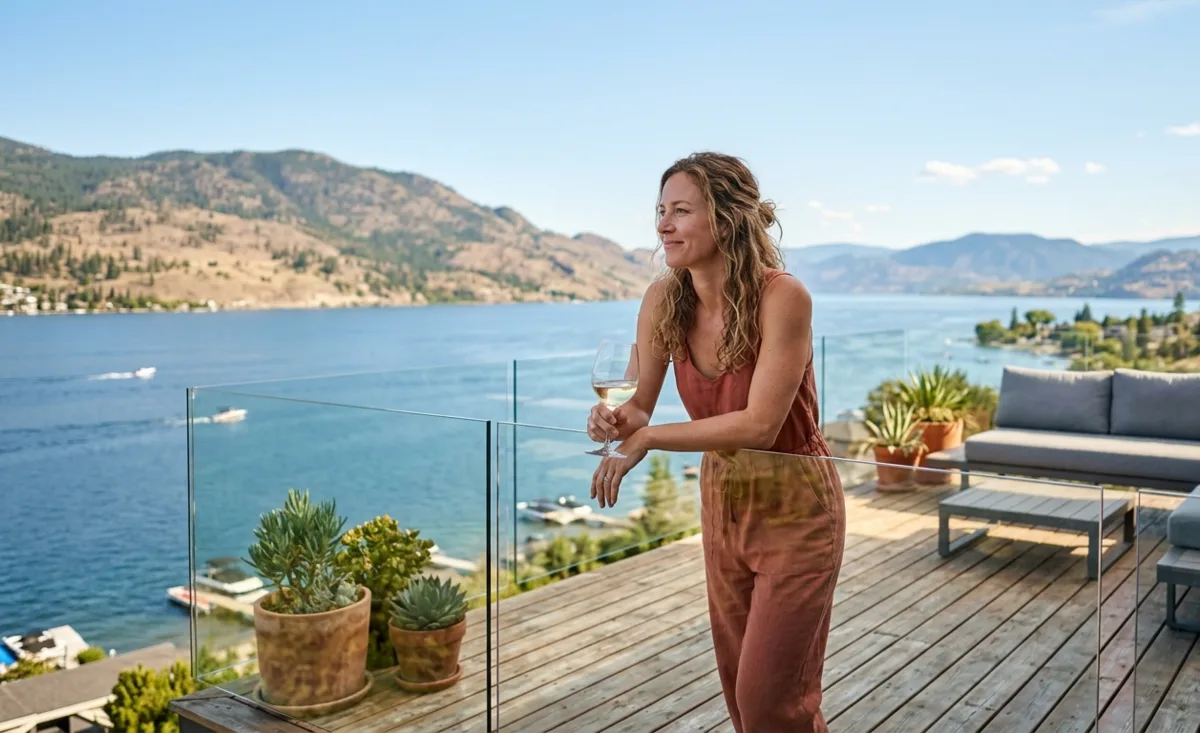
If your deck overlooks Okanagan Lake, Kalamalka Lake, or a valley panorama, glass is the only material that truly disappears. Every other option puts something between you and the view. Glass doesn’t. That’s why lakefront homeowners keep coming back to it.
Pros
- Completely unobstructed sightlines (the only railing that genuinely “vanishes”)
- 25+ year lifespan. The glass itself never degrades.
- Handles Okanagan freeze/thaw cycles without cracking
- Acts as a wind barrier without blocking light
- Adds real resale value on view properties. Lakefront Kelowna, West Kelowna, and Peachland buyers pay for the view, and glass keeps it front and centre.
Cons
- Highest upfront cost of any railing material
- Fingerprints, water spots, and pollen show easily (Okanagan spring pollen is brutal for this)
- Not a DIY project. Requires professional installation with precise measurements.
- Hardware is the weak point, not the glass itself. Insist on marine-grade 316 stainless steel.
- Custom panels have a 2-4 week lead time
Okanagan Climate Notes
Good news for Interior BC homeowners: less salt air than the coast means less hardware corrosion. Our dry summers also mean less frequent cleaning than Vancouver. Quarterly is usually enough for most Kelowna and Vernon locations. And extreme heat (35°C+) doesn’t affect tempered glass performance at all.
Want the full breakdown on glass deck railings? We cover styles, installation, and what to look for in hardware on our dedicated page. You can also see how glass stacks up against aluminum specifically in our glass vs aluminum railings guide.
Aluminum Railings: The Workhorse of BC Decks
There’s a reason aluminum dominates the mid-range railing market across British Columbia. It hits the sweet spot between cost, durability, and maintenance that most homeowners are looking for. Not the cheapest. Not the fanciest. Just the most practical for most decks. And honestly? It’s what we install more than anything else.
Pros
- Best value in the deck railing types lineup — balances cost and longevity
- 20-30 year lifespan with powder coating
- Near-zero maintenance. An annual 30-minute wash with soapy water is all it takes.
- Does not rust. Aluminum develops a protective oxide layer that actually shields it from further corrosion.
- Multiple styles available: pickets, horizontal bars, glass inserts, decorative patterns
- DIY kits available from BC suppliers if you want to save on installation
- Handles Okanagan snow loads and temperature cycling without issues
Cons
- Pickets obstruct views, so not ideal if you paid a premium for lakefront property
- Budget systems use thin aluminum that can bend on impact
- Powder coating can chip if struck by heavy objects (patio furniture, etc.)
- Fewer colour options than paint-grade wood
Okanagan Climate Notes
Powder coating resists UV fading from the Okanagan’s 300+ sunny days per year. No sealing, staining, or treatment needed through our winters. Aluminum handles the -15°C to 35°C range without expansion or contraction problems. The self-renewing oxide layer means spring runoff moisture isn’t a concern either.
Check out our aluminum railing options for styles and configurations we install across the Okanagan.
Cable Railings: Modern Look, Moderate Cost
Cable railings have picked up serious momentum in the last few years, especially on modern and contemporary builds around Kelowna and West Kelowna. Thin stainless steel cables are far less visible than pickets, giving you near-clear views at a lower price point than glass. They fill that gap between “I want to see through my railing” and “I can’t justify that kind of money for glass.” We don’t install cable systems ourselves, but we’ve worked alongside enough cable installers to know the real pros and cons.
Pros
- Near-unobstructed views. Cables are thin enough to practically disappear at distance.
- Modern, clean aesthetic that suits contemporary architecture
- Fills the price gap between aluminum and glass without the premium of frameless glass
- 20-30 year lifespan with stainless steel cables
- Works well on multi-level decks and staircases
- DIY-possible with wood posts and cable kits
Cons
- Cables stretch over time and need tensioning every 1-2 years
- Horizontal cables can create a “ladder effect” for kids. Some inspectors flag this.
- BC Building Code requires cables spaced so a 4″ sphere cannot pass through
- Low-grade stainless can still corrode. Use 316 marine-grade, not 304.
- Corner posts and end posts must be securely anchored to handle cable tension loads. This isn’t optional.
Okanagan Climate Notes
The dry Okanagan climate is actually an advantage here. Far less corrosion risk than coastal BC. Temperature swings do cause cable expansion and contraction though, so plan for annual tensioning. Snow and ice buildup on the cables themselves melts quickly because of the thin profile. And the intense Okanagan sun? Doesn’t degrade stainless steel cables one bit.
Composite Railings: Match Your Deck, Skip the Staining
Composite railings make the most sense in one specific scenario: you already have a composite deck and want everything to match. Trex, TimberTech, Fiberon. They all make railing systems designed to pair visually with their decking lines. If that’s your situation, composite is a strong pick. Outside of that? Aluminum usually wins on value.
Pros
- Pairs visually with composite decking for a cohesive look
- No staining, sealing, or painting. Ever.
- 25-30 year lifespan with quality brands
- Rot-proof, insect-proof, and mold-resistant
- Priced competitively with aluminum
- Multiple colour options (though you can’t repaint later if you change your mind)
Cons
- Heavier than aluminum, so it needs reinforced framing on longer spans
- Can fade with prolonged UV exposure (the Okanagan’s 300+ sunny days accelerate this)
- Limited design flexibility compared to aluminum or wood
- Sagging and bending are real risks on budget systems that lack metal reinforcement inside
- Solid profiles block sightlines. Not for view properties.
Okanagan Climate Notes
UV fading is the biggest concern in our region. Choose brands with strong UV warranties. Cheap composites will look noticeably different within 5-7 years under Okanagan sun. Composite handles freeze/thaw without cracking (better than PVC in extreme cold), and dry heat doesn’t warp it like it does wood. One thing to watch: dark colours absorb heat and can feel hot to the touch during 35°C+ summer days.
Wood Railings: Classic Look, High Maintenance Reality
I’ll be honest about wood. It looks fantastic the day it goes up. Warm, natural, fits perfectly with rustic and craftsman-style homes. But the Okanagan is one of the hardest climates in Canada for wood railings. The maintenance burden is real. I’ve replaced more rotted-out wood railings than I can count.
Pros
- Lowest upfront cost in the deck railing options lineup
- Natural aesthetic suits rustic, cabin, and craftsman-style homes
- Fully customizable — any shape, design, or finish you can imagine
- Cedar and pressure-treated options readily available from BC suppliers
- DIY-friendly with standard carpentry tools
Cons
- Shortest lifespan: 10–15 years even with consistent maintenance
- Annual staining and sealing required (2–4 hours per 20ft section, every single spring)
- Warps, cracks, and splinters — especially in the Okanagan’s dry heat
- Rot risk from snow sitting against posts through winter
- Carpenter ants are common in the Okanagan and love untreated wood
- Total lifetime cost often exceeds aluminum when you add up all the stain, sealer, and replacement parts
Okanagan Climate Notes
This is where wood struggles most. Dry summers with only 250–400mm of rainfall per year cause wood to crack and check. Temperature swings from -15°C to 35°C stress every joint. Snow sitting against posts through winter accelerates rot at the base — the exact spot you can’t see until it’s too late. Cedar performs better than pine, but still needs annual treatment. And the intense UV fades stain faster here than on the coast, so plan for yearly reapplication.
BC Building Code Requirements for Deck Railings
Every railing material has to meet the same code. This isn’t negotiable, and it doesn’t matter how good your railing looks if it fails inspection. Here are the requirements that apply to every deck railing materials comparison in BC.
Guard Height
- Decks 24″ (600mm) to 5’10” (1.8m) above grade: 36″ minimum guard height
- Decks over 5’10” (1.8m) above grade: 42″ minimum guard height
- Some municipalities (like Vancouver) enforce 42″ across the board
- Kelowna follows the standard BC Building Code 36″/42″ threshold
Baluster & Opening Spacing
- No opening can allow a 100mm (4″) sphere to pass through
- Gap between bottom rail and deck surface: maximum 4″
- This applies to every material — glass panels, aluminum pickets, cable spacing, composite balusters, wood pickets
Load Requirements
- Guards must resist specific lateral force loads (varies by occupancy type)
- Residential guards are designed for concentrated and distributed loads per BC Building Code
- Glass guards use tempered or laminated glass, minimum 1/2″ thick
- Cable railing posts must handle tension loads at corners and ends
Climbing Prevention
- Guards cannot have climbable elements between 140mm and 900mm above the deck
- Horizontal elements (cable, horizontal aluminum bars) can be flagged by inspectors
- Vertical pickets, solid glass, and solid composite panels are safest for code compliance
For more on BC deck railing requirements and the systems we build, see our Okanagan deck railings page.
Which Railing Material Is Best for Your Okanagan Deck?
After installing railings across the Okanagan for years, I’ve found it usually comes down to two questions: Do you have a view worth showcasing? And how much maintenance are you willing to do? Here’s the decision framework I walk clients through.
Choose Glass If…
- Your deck faces Okanagan Lake, Kalamalka Lake, or mountain views
- You own a modern or contemporary home
- Your budget allows for a premium material
- You want maximum resale value on a view property
Choose Aluminum If…
- You want the best balance of cost, durability, and low maintenance
- Your deck doesn’t have a premium view to showcase
- You prefer proven reliability over aesthetics
- You want dependable mid-range value
Choose Cable If…
- You want near-clear views at lower cost than glass
- Modern aesthetic matters but glass is out of budget
- You’re comfortable with periodic cable tensioning every year or two
Choose Composite If…
- You already have a composite deck and want a matching look
- Zero maintenance is the priority
- Views aren’t the selling point of your outdoor space
Choose Wood If…
- Budget is tight and you’re handy with a stain brush
- Rustic or cabin aesthetic is important to your home’s character
- You’re building a short-term deck (under 10 years before major renovation)
A hybrid approach works too. We’ve installed glass on the view-facing sides and aluminum on the rest of the same deck. Cuts cost noticeably while keeping the sightlines where they matter most.
Compare the two most popular options side-by-side in our glass vs aluminum railings guide.
Frequently Asked Questions
What is the most durable deck railing material for BC weather?
Glass and aluminum are the most durable deck railing materials for BC’s climate. Glass itself never degrades and lasts 25+ years when installed with marine-grade stainless hardware. Powder-coated aluminum lasts 20–30 years with virtually no maintenance. Both handle the Okanagan’s temperature swings (-15°C to 35°C), dry summers, and winter snow without problems. Composite comes close at 25–30 years but can fade with heavy UV exposure. Wood is the least durable at 10–15 years, requiring annual staining and sealing. For longevity with minimal effort, aluminum offers the best value in BC.
Which deck railing materials cost the most, and which cost the least?
From lowest to highest upfront cost, the usual order in BC is wood, composite, aluminum, cable, then glass. Wood is the cheapest to install but the most expensive to maintain over the years, while aluminum delivers the best long-term value for most decks. Glass is the premium choice, usually reserved for lakefront and view properties. Because the final number depends on your deck size, height, railing style, and material, the most accurate way to know is a free on-site quote. High decks over 6 feet need 42-inch guards, which adds to the material required. We’ll give you a clear, no-pressure number for your exact deck.
Do cable railings meet BC building code?
Yes, cable railings meet BC Building Code when installed correctly. Cables must be spaced so a 100mm (4-inch) sphere cannot pass between them, and guard height must be 36 inches (decks under 5’10”) or 42 inches (decks over 5’10”). The main code concern is climbing prevention — horizontal cables can be interpreted as a climbing hazard for children. Some BC municipalities are stricter than others on this point. Posts must be strong enough to handle cable tension loads, especially at corners. Check with your local building department before installing cable railings to confirm they’ll pass inspection in your area.
What deck railing material requires the least maintenance?
Aluminum requires the least maintenance of any deck railing material. An annual 30-minute wash with soapy water is all powder-coated aluminum needs — no staining, sealing, or painting. Composite is a close second, needing only occasional washing but with potential UV fading over time. Glass requires more cleaning effort (quarterly in the Okanagan Interior, monthly in coastal areas) to stay clear, though the structure needs no treatment. Cable railings need bi-annual tensioning. Wood demands the most work: annual staining, sealing, and inspection for rot, cracking, and insect damage — roughly 4–6 hours per year for a typical deck.
Is glass railing worth the extra cost for an Okanagan deck?
Glass railing is worth it if your Okanagan deck has a premium view — Okanagan Lake, Kalamalka Lake, or valley panoramas. Frameless glass is the only material that truly disappears, making the view the focal point. On lakefront properties, glass railings can increase perceived home value because buyers pay for the view. If your deck overlooks a backyard or neighbour’s fence, glass is overkill — aluminum at half the cost delivers better value. The Okanagan’s dry Interior climate also means less cleaning than coastal BC, making glass more practical here than in Vancouver. Consider a hybrid approach: glass on the view side, aluminum on the rest.
Ready to Choose the Right Railing for Your Deck?
Okanagan Patio Covers designs, manufactures, and installs glass and aluminum railing systems across Kelowna, Vernon, West Kelowna, Penticton, and Lake Country — backed by a 30-year warranty and 1,500+ projects since 2005. Free on-site consultations with honest material recommendations.
Schedule Your Free Consultation


Ready to Start Your Railing Project?
Get a free, no-pressure quote for glass or aluminum railings. We’ll come to your deck, assess the layout, and recommend the best material for your view and budget.
Serving Kelowna, West Kelowna, Vernon, Penticton, Lake Country & Salmon Arm