

Patio Cover Snow Load Requirements in BC (2026 Guide): Engineering Standards & Safety
In BC, your patio cover isn’t just fighting summer sun and rain. It needs to survive the weight of wet February snow without bending, sagging, or collapsing. This guide breaks down exactly what snow load ratings mean, what the BC Building Code requires for the Okanagan, and how to know if your patio cover is actually engineered to handle our winters.
What Is Snow Load and Why Does It Matter?
Snow load is the downward force snow exerts on a structure, measured in pounds per square foot (PSF) or kilopascals (kPa). Think of it as the weight of snow pressing down on every square foot of your patio cover’s surface.
PSF vs kPa: Understanding the Units
Building codes use both measurement systems. Here’s how they convert:
- 1 kPa = approximately 21 pounds per square foot (PSF)
- 2.0 kPa = roughly 42 PSF
- 40 PSF = about 1.9 kPa
Why Wet Snow Is the Real Challenge
Not all snow weighs the same. BC’s coastal influence means we often get heavy, wet snow rather than the light powder found in Alberta or the Interior mountains. Here’s the difference:
| Snow Type | Weight per Cubic Foot | Impact |
|---|---|---|
| Fresh Powder | 3-8 lbs/ft³ | Light, fluffy (Alberta winters) |
| Settled Snow | 15-20 lbs/ft³ | After a few days on ground |
| Wet Snow | 20-30 lbs/ft³ | Common in Okanagan (heavy!) |
| Ice/Slush | 50-60 lbs/ft³ | Worst case scenario |
A foot of wet snow on a 12×20 ft patio cover weighs over 5,000 pounds. That’s why engineering matters.
BC Building Code Requirements for Patio Covers

Part 9 of the BC Building Code
Residential patio covers fall under Part 9 – Housing and Small Buildings of the BC Building Code 2024. Key requirements include:
- Any patio cover attached to your home requires a building permit
- Structures must be designed for specified snow loads per Table 4.1.6.2
- Footings must meet Section 9.15 (cannot just sit on concrete slabs)
- Ledger attachments must be properly flashed and structurally sound
Engineer Stamp Required
Unlike a simple deck railing, patio covers in BC require professional engineering sign-off. Here’s why:
- Snow load calculations require understanding of tributary areas, drift factors, and slope coefficients
- Beam sizing must account for deflection limits (typically L/180)
- Post spacing and footing dimensions are location-specific
- Building inspectors won’t approve permits without stamped drawings
Regional Snow Load Map – Okanagan Valley
The Okanagan isn’t one uniform snow zone. Ground snow loads vary significantly based on elevation and proximity to the lake. Here’s the breakdown:
Kelowna & Central Okanagan
| Ground Snow Load | 1.8-2.0 kPa (38-42 PSF) |
| Applies to | Valley floor, Glenmore, Rutland, most of Kelowna |
| Typical Design | 40 PSF minimum, 50 PSF for safety margin |
Vernon & North Okanagan
| Ground Snow Load | 2.0-2.4 kPa (42-50 PSF) |
| Applies to | Vernon city, Coldstream, rural areas |
| Notes | Higher than Kelowna due to elevation and interior location |
Penticton & South Okanagan
| Ground Snow Load | 1.6-1.8 kPa (34-38 PSF) |
| Applies to | Penticton, Summerland, Naramata (lower elevations) |
| Notes | Warmest zone, less snow accumulation |
Lake Country & Higher Elevations
| Ground Snow Load | 2.0-2.6 kPa (42-54 PSF) |
| Applies to | Lake Country, Ellison, Winfield, areas above 500m elevation |
| Notes | More snow than valley floor |
Big White & Mountain Areas
| Ground Snow Load | 3.0-4.0+ kPa (65-85+ PSF) |
| Applies to | Big White, Silver Star, Apex, mountain properties |
| Requirements | Site-specific engineering required, higher costs |
Ground Snow Load vs Roof Snow Load
Here’s where it gets technical but important: the ground snow load is not the same as the design load for your roof.
The Calculation Formula
Per the National Building Code Section 4.1.6, roof snow load is calculated as:
Ss = Is × Ss(Cb × Cw × Cs × Ca)
Where:
- Is = Importance factor (1.0 for residential patio covers)
- Ss = Specified ground snow load (from climate data)
- Cb = Basic roof snow load factor (0.8 for most roofs)
- Cw = Wind exposure factor (usually 1.0 for residential)
- Cs = Slope factor (reduces load on steeper roofs)
- Ca = Drift factor (important for attached covers)
Slope Factor Makes a Difference
The slope of your patio cover affects how much snow accumulates:
| Roof Slope | Cs Factor | Effective Load Reduction |
|---|---|---|
| Flat (0-15°) | 1.0 | No reduction (worst case) |
| 3:12 (14°) | 0.88 | 12% reduction |
| 4:12 (18°) | 0.75 | 25% reduction |
| 6:12 (27°) | 0.50 | 50% reduction |
A 3:12 slope (our standard) on a Kelowna patio with 2.0 kPa ground load results in roughly 1.4 kPa actual roof design load after factors.
Why Ground Load Still Matters
Even though the roof sees less load than ground, engineers must also account for:
- Unbalanced loading: Snow drifting to one side
- Accumulation zones: Valleys between cover and house
- Rain-on-snow events: Heavy rain soaking into accumulated snow (increases weight dramatically)
- Safety factors: Code requires 1.5x factor for ultimate limit states
Engineering Standards for Patio Covers
BC engineers follow specific design standards when stamping patio cover drawings. Here’s what goes into a proper design:
ASCE 7-16 & NBC 2020 Standards
Engineers reference:
- National Building Code of Canada (NBC) 2020: Primary code for snow loads (Section 4.1.6)
- ASCE 7-16: American standard for minimum design loads (often referenced for complex geometry)
- Wood Design Manual (CSA O86): For timber beams and posts
- Aluminum Design Manual: For extruded aluminum structures
Beam Deflection Limits
It’s not just about not collapsing. Patio covers must also meet deflection (bending) limits:
| Limit | Standard | What It Means |
|---|---|---|
| L/180 | Live load deflection | 12 ft beam bends max 0.8 inches under snow |
| L/240 | Total load deflection | Stricter limit for appearance/drainage |
| L/360 | Glass panels | Required for insulated glass patio covers |
Deflection limits prevent:
- Visible sagging (looks bad, causes drainage issues)
- Ponding water (creates additional load from pooling)
- Glass panel stress (prevents cracking)
- Fastener loosening over time
Post Spacing & Footing Sizing
Engineers determine post spacing based on beam capacity. Typical aluminum patio cover specs:
| Post Spacing | 8-10 ft on center (standard), 6-8 ft (higher loads) |
| Beam Size | 6×6 or 8×8 aluminum extrusion |
| Footing Depth | 24-36 inches below grade (frost depth) |
| Footing Diameter | 12-16 inches (sonotube) |
What Makes a Patio Cover “Snow-Rated”?
Not all patio covers are created equal. Here’s how to tell if a system is actually engineered for BC snow loads:
Certification & Engineering Stamps
A legitimate snow-rated system includes:
- Engineer stamp: From a BC-licensed Professional Engineer (P.Eng.)
- Location-specific calculations: Not generic “good for snow” marketing
- Manufacturer certification: If prefab, manufacturer provides load tables
- Building permit approval: Municipality accepted the engineering
Aluminum Gauge Matters
Aluminum patio cover panels come in different thicknesses:
| Panel Gauge | Thickness | Suitable For |
|---|---|---|
| 0.019″ | ~0.5mm | Non-snow regions (California, Arizona) |
| 0.024″ | ~0.6mm | Light snow (coastal BC) |
| 0.032″ | ~0.8mm | Standard for Okanagan (what we use) |
| 0.040″+ | ~1.0mm+ | Heavy snow zones (Big White) |
Most US manufacturers spec 0.019″ panels because they’re designed for Arizona and California climates. Those won’t pass BC engineering without serious reinforcement.
Red Flags: Non-Engineered Systems
Watch out for these warning signs:
- “Good to 100 PSF” claims without engineer stamp or region specified
- DIY kits from US suppliers without BC-specific engineering
- Contractors who say “We’ve never had a problem” instead of showing permits
- No mention of building permits or engineering in the quote
- Posts sitting on existing concrete without footings
Design Features That Handle Snow Better
Minimum 3:12 Slope
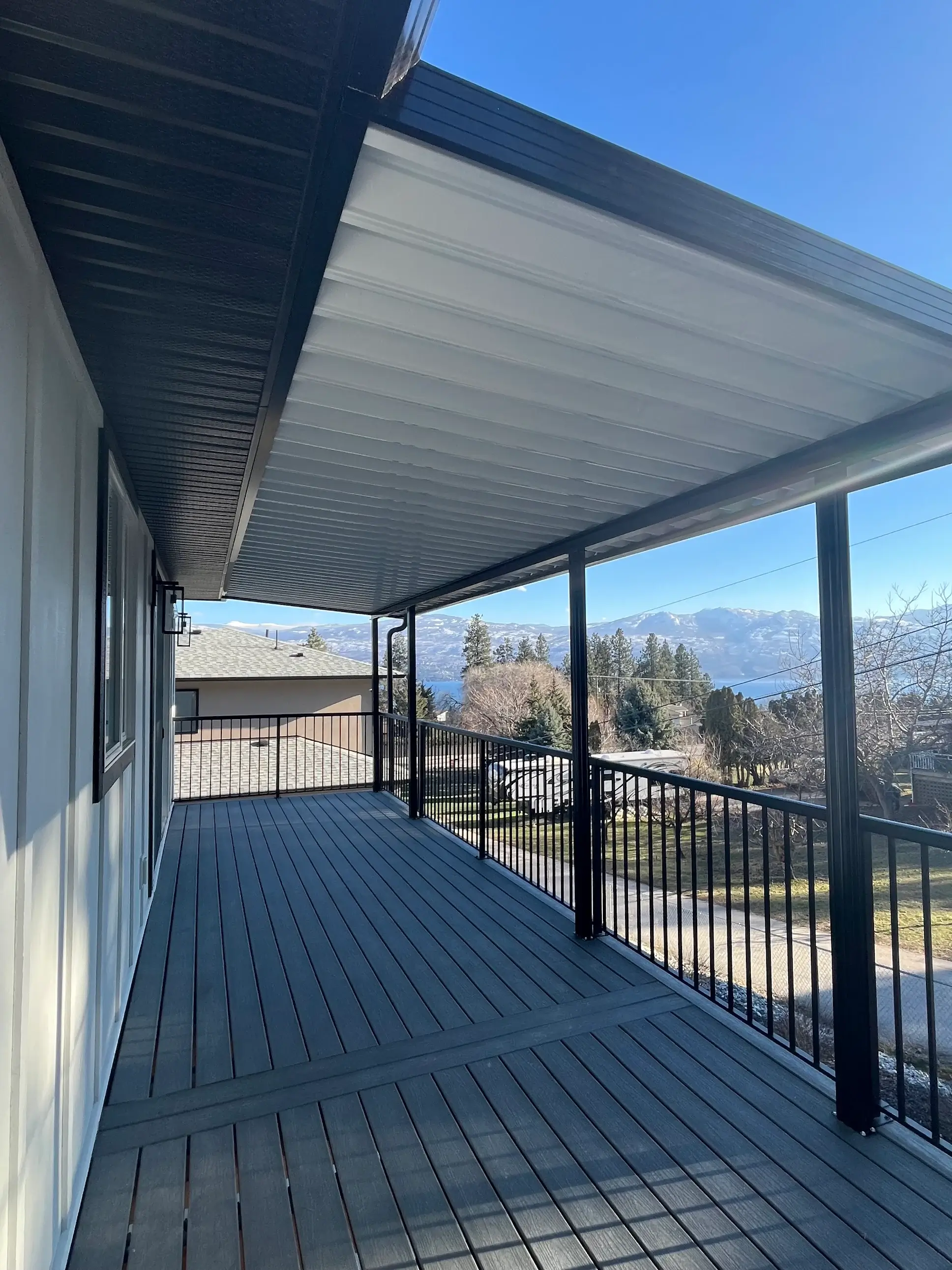
We recommend at least a 3:12 pitch (3 inches of rise per 12 inches of run) for the Okanagan. Here’s why:
- Snow shedding: Reduces accumulation compared to flat roofs
- Water drainage: Prevents ice dams and pooling
- Lower design loads: Slope factor reduces required strength (see calculation above)
- Aesthetic: Looks better than a flat cover
Gutter Systems & Drainage
Proper drainage isn’t just about rain. It prevents:
- Ice damming: Meltwater refreezing at edges (adds weight and stress)
- Ponding: Water pooling creates localized load concentrations
- Overflow onto walks: Prevents ice buildup on stairs and patios
Insulated Panels vs Bare Aluminum
Insulated aluminum panels (EPS or polyurethane foam core) offer structural advantages:
| Feature | Bare Aluminum | Insulated Panel |
|---|---|---|
| Rigidity | Requires closer purlin spacing | Foam core stiffens panel significantly |
| Snow Load | Relies on structure alone | Panel acts as structural member |
| Thermal Performance | Poor (conducts heat) | R-value 8-12 (reduces ice melting/refreezing) |
| Noise | Drumming in rain/hail | Dampens sound |
For the Okanagan, insulated panels make sense both structurally and for year-round usability.
Reinforcement Options for Higher Loads
For Big White or heavier snow zones, engineers may specify:
- Closer post spacing (6 ft instead of 10 ft)
- Larger beam sections (8×8 instead of 6×6)
- Additional purlins (roof joists) for panel support
- Steel reinforcement in aluminum beams
- Thicker panel gauge (0.040″ instead of 0.032″)
Permits & Engineering Process
Here’s what the permit and engineering process looks like in the Okanagan:
Step 1: Site Assessment
Your contractor or engineer determines:
- Property location (determines ground snow load from climate data)
- Existing house structure (ledger attachment capacity)
- Soil conditions (affects footing design)
- Setbacks and zoning compliance
Step 2: Engineering Design
A structural engineer (typically subcontracted by the installer) creates:
- Stamped structural drawings showing post locations, beam sizes, footing details
- Load calculations certified for your specific address
- Ledger attachment details (if applicable)
- Connection details for beams, posts, and panels
Cost: $500-1,200 for residential patio cover engineering (typically included in installation quotes)
Step 3: Building Permit Application
Your contractor submits to the municipality:
- Engineered drawings with P.Eng. stamp
- Site plan showing setbacks
- Building permit application form
Timeline: 2-4 weeks for approval in most Okanagan municipalities
Cost: $150-400 permit fee (varies by municipality and project value)
Municipality Variations
| Municipality | Permit Timeline | Notes |
|---|---|---|
| Kelowna | 2-3 weeks | Online submission available, efficient process |
| Vernon | 3-4 weeks | Thorough review, sometimes requests clarifications |
| West Kelowna | 2-3 weeks | Similar to Kelowna, smaller volume |
| RDCO (rural) | 3-5 weeks | Longer for complex or hillside properties |
Step 4: Inspections
Two inspections are typically required:
- Footing inspection: Before concrete is poured (ensures depth, diameter, rebar placement)
- Final inspection: After installation is complete (verifies it matches engineered drawings)
Inspections are scheduled through your municipality’s building department. Contractors coordinate these as part of the project.
Top 5 Snow Load Failure Modes
When patio covers fail under snow, it’s usually one of these five reasons:
1. Undersized Beams
Beams that look strong enough but weren’t actually calculated for the span and load. Signs:
- Visible sagging after first heavy snow
- Cracking sounds under load
- Panels pulling apart at seams
Prevention: Engineer-stamped beam sizing for your specific span and snow load
2. Excessive Post Spacing
Posts placed too far apart to support the beam. Common with DIY or budget installs trying to save on materials.
Typical failure: Beams bend between posts, causing panels to buckle or detach
Prevention: Follow engineered post spacing (usually 8-10 ft max in Okanagan)
3. Inadequate Footings
Posts sitting on existing concrete slabs or shallow footings that shift under load. This violates BC Building Code Section 9.15.
What happens: Posts sink, shift, or kick out at the base, causing catastrophic structural failure
Prevention: Proper footings below frost line (24-36″ deep), sized per engineering
4. Flat or Near-Flat Design
Covers with little to no slope accumulate far more snow than sloped designs.
- Snow doesn’t shed—just keeps piling up
- Melting creates ice dams at edges
- Ponding water adds weight and prevents drainage
Prevention: Minimum 3:12 slope, proper gutter system
5. Ledger Attachment Failure
For attached patio covers, the ledger board connection to the house is critical.
Common mistakes:
- Lag bolts into siding instead of structure
- Insufficient bolt spacing or size
- No flashing (causes rot, weakening connection over time)
- Attaching to cantilevered floor joists (not designed for that load)
Prevention: Engineered ledger detail, proper flashing, attachment to rim joist or blocking
Choosing the Right Snow Load Rating
So what snow load rating do you actually need? Here’s a decision framework:
Kelowna Valley Floor
- Minimum code: 1.8-2.0 kPa (~40 PSF ground load)
- Our recommendation: Design for 2.2 kPa (~46 PSF) for margin
- Why: Climate change is increasing extreme weather events. Better to over-engineer slightly than deal with failure.
Vernon & Lake Country
- Minimum code: 2.0-2.4 kPa (~42-50 PSF)
- Our recommendation: 2.6 kPa (~54 PSF) for rural/elevated properties
Big White, Silver Star, Mountain Properties
- Requires site-specific engineering (snow load varies dramatically with elevation)
- Expect 3.0+ kPa minimum, possibly much higher
- May require steel beams or very tight post spacing
- Significantly higher material and engineering costs
When to Over-Engineer
Consider specifying a higher rating if:
- Your property is on a hillside (microclimate can differ from valley data)
- You have complex roof geometry that creates drift zones
- The cover is over a hot tub or expensive outdoor furniture
- You plan to enclose it later (adding walls increases load)
- You want to avoid snow removal maintenance
Cost Impact
Moving from a 40 PSF to 50 PSF design typically adds:
- 5-10% to material costs (larger beams, closer posts)
- Minimal engineering cost difference (same process)
- Peace of mind: priceless
Frequently Asked Questions
How much weight can a patio cover hold?
A properly engineered patio cover in the Okanagan is designed to hold 40-50 PSF (pounds per square foot) of snow load. For a typical 12×20 ft cover, that’s 9,600-12,000 pounds total. The actual capacity depends on beam size, post spacing, and engineering specifications for your specific location.
What is snow load rating?
Snow load rating is the maximum weight of snow a structure can safely support, measured in PSF (pounds per square foot) or kPa (kilopascals). In BC, this is determined by the National Building Code and varies by region. Kelowna requires roughly 40 PSF ground snow load; Vernon needs 42-50 PSF.
Do I need a permit for a patio cover?
Yes. In BC, any patio cover attached to your home requires a building permit, regardless of size. Freestanding structures over 10m² (107.6 sq ft) also require permits. The permit must include engineer-stamped drawings showing snow load calculations. See our full guide: Patio Cover Permits in BC.
How much snow can a patio cover handle?
It depends on the snow type and your cover’s rating. A patio cover rated for 40 PSF can handle roughly 12-15 inches of wet snow or 24-30 inches of powder. Wet Okanagan snow weighs 20-30 lbs per cubic foot, so depth isn’t the only factor—density matters more.
What snow load rating do I need in Kelowna?
Kelowna requires 1.8-2.0 kPa ground snow load (approximately 38-42 PSF). We recommend designing for 40-50 PSF to meet code with a safety margin. Higher elevations like Lake Country or rural areas may require 50+ PSF. Your engineer determines the exact requirement based on your property location.
Do I need an engineer for a patio cover in BC?
Yes. BC Building Code Section 4.1.3.2 requires structural designs be prepared and stamped by a professional engineer or architect. Building departments will not issue permits without engineered drawings. Engineering typically costs $500-1,200 and is usually included in professional installation quotes.
Can aluminum patio covers handle BC snow?
Yes, when properly engineered. Aluminum patio covers use 0.032″ gauge panels and engineered beam systems that meet BC snow loads. The key is professional engineering—not all aluminum systems are designed for snow. Avoid US-market DIY kits designed for Arizona climates (often only 0.019″ gauge).
How do I know if my patio cover is snow-rated?
Check for: (1) a BC-licensed engineer stamp on the drawings, (2) a building permit from your municipality, (3) footing inspections that passed code, and (4) contractor documentation specifying the design snow load in PSF or kPa. If you can’t find these, your cover may not be engineered.
What happens if snow exceeds my cover’s rating?
Exceeding the design snow load can cause beam deflection (sagging), panel buckling, post failure, or catastrophic collapse. If you get an unusually heavy snowfall, remove snow before it reaches 12+ inches (especially wet, heavy snow). Use a roof rake or soft push broom—never a metal shovel.
How much does engineering cost for a patio cover?
$500-1,200 for a residential patio cover in the Okanagan. Complex designs, large spans, or mountain properties may cost more. Reputable installers include engineering in their project cost. Be wary of quotes that don’t mention engineering—it’s required by law.
How often should I remove snow from my patio cover?
If engineered properly, you shouldn’t need to remove snow regularly. However, remove snow if: (1) accumulation exceeds 12 inches of wet snow, (2) you notice sagging or unusual sounds, or (3) a major storm dumps 18+ inches. Use a roof rake or soft broom—avoid metal tools that can damage panels.
Are insulated patio covers better for snow loads?
Yes, for two reasons. First, the foam core stiffens the panel, adding structural capacity. Second, insulation reduces heat transfer, which prevents snow from melting and refreezing into heavy ice. Insulated panels also reduce noise from rain and hail. See our insulated aluminum patio covers for more details.
Get a Snow-Rated Patio Cover That’s Actually Engineered
Every OKPC patio cover includes professional engineering, stamped drawings, and full permit handling. No guesswork, no shortcuts—just code-compliant construction you can trust.
Get Your Free QuoteReady to Start Your Project?
Get a free, no-pressure quote. We’ll help you choose the right solution for your backyard.
Serving Kelowna, West Kelowna, Vernon, Penticton, Lake Country & Salmon Arm
Related Guides