

How to Measure for a Patio Cover
Bad measurements are the reason patio covers end up crooked, leaking, or stuck in permit limbo. We’ve seen homeowners order $3,000 worth of materials based on rough guesses, only to find out their wall isn’t straight and their posts are in the wrong spot. Here’s how to measure properly the first time.
Tools You’ll Need
Don’t start measuring without the right gear. Here’s the list:
- 25-foot tape measure — spring-loaded, with a locking tab
- 4-foot level — for checking surfaces and establishing slope
- Laser distance measurer — optional but saves time on heights (under $50 at any hardware store)
- Pencil and notepad — write everything down. Don’t trust your memory.
- Smartphone camera — photos from multiple angles help when you’re ordering materials or talking to contractors
- A helper — seriously, measuring anything over 10 feet by yourself is a recipe for inaccuracy
Measuring Width and Length
These are your two most important numbers. Get them wrong and nothing fits.
Width (Along the House)
Measure the full length of the house wall where the cover will attach. Start from one edge of the area you want covered and go to the other. Measure to the nearest half-inch — don’t round.
- Note any jogs or offsets in the wall
- Mark where doors and windows are (you don’t want a post blocking a door)
- If you want the cover wider than the house wall, note that too
Projection (Out From the House)
This is how far the cover extends from your house. Our standard sizes guide breaks down common dimensions, but here’s a quick reference for what fits under each projection:
- 8 feet: fits a small dining set or a couple of chairs
- 10 feet: fits a standard patio table with room to walk behind chairs
- 12 feet: enough for a table, a grill area, and circulation space
- 14+ feet: two distinct zones (dining + lounge, or dining + grill)
Height and Attachment Point
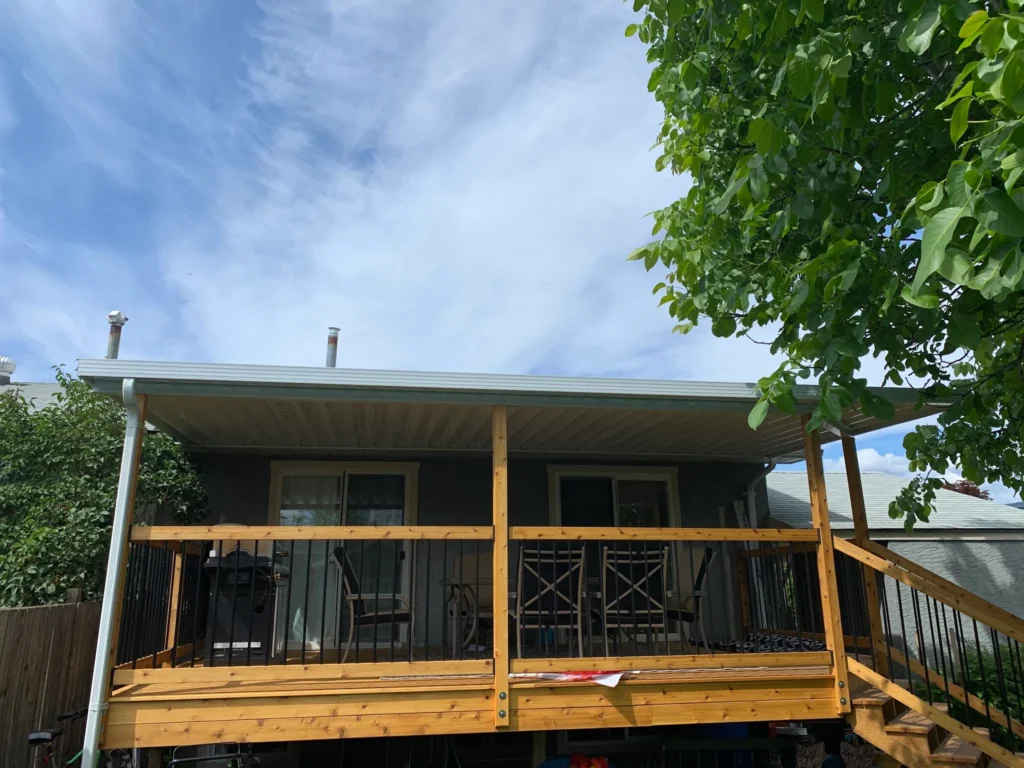
Where the cover attaches to your house determines everything about how it looks and drains.
Measuring Height to Eaves
Stand at your house wall and measure from the patio surface straight up to the bottom of your eaves (the part of the roof that overhangs the wall). This tells you the maximum attachment height.
- Minimum clearance underneath: 8 feet from finished patio surface
- Ideal height: 9-10 feet — feels spacious, works well for ceiling fans
- Measure at multiple points — if your patio slopes, the height changes across the width
Eaves Overhang
Measure how far your roof extends past the wall (the overhang). Hold a level horizontally against the wall and measure out to the drip edge of the roof. This measurement matters because:
- It tells you where the ledger board needs to sit
- A long overhang (18+ inches) may mean you attach to the fascia board instead of the wall
- The cover flashing needs to tuck under the existing roofing
Slope and Drainage
Every patio cover needs slope for water to run off. Get this wrong and you’ll have ponding, leaks, and eventually a sagging roof.
The Minimum Slope Rule
You need at least 1 inch of drop per foot of projection. So:
- 10-foot projection = 10 inches of drop minimum
- 12-foot projection = 12 inches of drop minimum
- 14-foot projection = 14 inches of drop minimum
In the Okanagan, we recommend 1.5 inches per foot for better snow shedding. That extra half-inch makes a real difference when wet snow sits on your cover in March.
Checking Your Existing Patio Surface
Place your level on the patio surface. Is it level? Sloping toward the house? Away from it? If it slopes toward the house, you need to account for that in your drainage plan — the last thing you want is water running toward your foundation.
Identifying Obstructions
Walk the entire area and note everything that could interfere with the cover structure or posts:
On the House Wall
- Windows and doors (including swing direction)
- Outdoor light fixtures
- Electrical outlets and junction boxes
- Hose bibs
- Gas meter and gas lines
- Dryer vents, bathroom exhaust vents
- AC condenser unit
In the Patio Area
- Hot tub or plumbing connections
- Underground sprinkler lines (call BC One Call: 1-800-474-6886 before digging post holes)
- Trees or large shrubs that posts would hit
- Septic tank or drain field access (don’t block it)
- Retaining walls or grade changes
Measure the exact position of each obstruction: distance from the nearest corner of the house, height from the patio surface, and how far it sticks out from the wall.
Checking for Square
Here’s the thing nobody mentions: your house wall might not be straight, and your patio might not be square. If you assume it is and it’s not, everything is off.
The 3-4-5 Triangle Method
- Pick a starting point on the wall where the cover will begin
- Measure 3 feet along the wall and mark it
- Measure 4 feet out from the wall at your starting point (perpendicular)
- The diagonal between those two marks should be exactly 5 feet
If it’s not 5 feet, the corner isn’t square. Note the actual diagonal measurement. For large projects, use 6-8-10 or 9-12-15 for more accuracy (same ratio, bigger numbers).
Checking the Wall for Straight
Snap a chalk line along the wall at your attachment height. If there are bulges or dips, the ledger board won’t sit flat. Note any variations over 1/4 inch — they’ll need to be shimmed during installation.
Planning Post Placement
Posts go at the outer edge of the cover, supporting the beam. Get the placement right and the cover looks clean. Get it wrong and you have posts blocking walkways, furniture, or worse — your sliding door.
Spacing Guidelines
| Span Between Posts | Beam Size Needed | Notes |
|---|---|---|
| 8 feet | 2×8 aluminum | Standard residential |
| 10 feet | 2×10 aluminum | Most common spacing |
| 12 feet | 2×12 aluminum | Wider opening, fewer posts |
| 14+ feet | Engineered beam | Requires engineering calculation |
Post Position Rules
- Never place a post in front of a door
- Keep posts 12+ inches from the edge of the patio slab
- Consider furniture layout — a post in the middle of where your table goes is a problem
- Each post needs a concrete footing at least 4 feet deep (Okanagan frost depth)
Common Measuring Mistakes
We see these on almost every homeowner-measured project that comes to us:
- Rounding measurements: “About 14 feet” is not a measurement. Write down 14 feet 7-1/2 inches. Rounding errors add up.
- Measuring to the wall instead of the attachment point: If your ledger board goes on the fascia, measure to the fascia — not the wall behind it.
- Ignoring ground slope: If the patio drops 3 inches over 20 feet, your post heights are different on each side. Measure heights at every post location.
- Forgetting setbacks: Check with your municipality — our permits guide has the details. Most Okanagan cities require structures to be 1-2 meters from property lines. Measure your property line before finalizing the cover width.
- Not accounting for drainage slope: If your attachment point is 9 feet and you need 12 inches of slope for a 12-foot projection, the outer edge is at 8 feet. Plan ahead.
What to Bring to Your Quote Appointment
If you’re getting a professional quote instead of DIY, bring this to save everyone time:
- Your sketch with all measurements
- Photos from at least 3 angles (straight on, looking along the wall, from the yard looking at the house)
- Notes on any obstructions
- Your rough idea of projection and coverage area
- Any HOA or strata restrictions you know about
Or skip the measuring entirely and book a free on-site measure — every quote includes one. We’ll bring the laser measurer and get everything to the exact millimeter. Check our cost guide for pricing, or head to our DIY installation guide if you’re planning to build it yourself.
Frequently Asked Questions
What measurements do I need for a patio cover quote?
At minimum: width along the house wall, desired projection (depth), and height from patio surface to the eaves. Photos help a lot too. If you have measurements of obstructions (light fixtures, windows, gas meter), that speeds up the quote. Or just book a free site visit and we’ll measure everything ourselves.
How do I measure for a patio cover on uneven ground?
Measure the height from the ground to your attachment point at every spot where a post will go. If the ground drops 4 inches across the span, your posts on the low side need to be 4 inches taller. Also check whether the patio slopes toward or away from the house — that affects drainage planning.
How much slope does a patio cover need?
Minimum 1 inch of drop per foot of projection. So a 12-foot-deep cover needs at least 12 inches of slope. In the Okanagan, we recommend 1.5 inches per foot for better snow shedding. The slope goes from the house wall (high side) to the outer edge (low side).
What’s the minimum height for a patio cover?
Eight feet of clearance from the patio surface is the standard minimum. But 9-10 feet feels much more comfortable, allows for ceiling fans, and gives better headroom at the outer edge where the roof slopes down. If your eaves are low, the minimum height limits how far out the cover can project.
Should I measure in feet or metric?
Use whatever your tape measure shows. Most Canadian tape measures show both. We work in imperial for construction but convert as needed. The important thing is to be precise and consistent — don’t mix feet and metric in the same sketch. Write 14′ 7-1/2″ or 4.45m, not “about 14 and a half feet.”
Can I just send you photos instead of measuring?
Photos help us understand the layout, but they’re not enough for accurate quoting. We need actual numbers for width, projection, and height. That said, every quote includes a free on-site measurement where we bring laser tools and get exact dimensions. You don’t have to measure if you don’t want to — just call us.
Want Us to Measure for You?
Every quote includes a free on-site measurement. We bring the laser tools and get everything right the first time.
Book Your Free Measurement
Ready to Start Your Project?
Get a free, no-pressure quote. We’ll measure your space and help you pick the right cover.
Serving Kelowna, West Kelowna, Vernon, Penticton, Lake Country & Salmon Arm