

Patio Cover Design Ideas: 15+ Styles for Your Okanagan Outdoor Space
Looking for patio cover design ideas that actually work in the Okanagan? This guide covers 15+ styles we’ve built across Kelowna, West Kelowna, Vernon, and Penticton. Modern flat-roof panels, rustic wood-grain finishes, and everything between. Honest advice on what looks good, what lasts, and what fits your home.
Your patio cover is the ceiling of your outdoor living room. Pick the wrong design and it sticks out like a sore thumb. Pick the right one and it looks like it was always part of the house.
I’ve installed hundreds of covers across the valley over the past decade. The biggest lesson? Materials matter, but design matters just as much. Two homeowners can choose the same aluminum patio cover system and end up with completely different results based on roofline, colour, and how the cover ties into their existing architecture.
This guide walks through every major style (modern, traditional, and rustic) plus colour options, lighting ideas, and layout decisions. Building new or replacing an old cover? You’ll find something here that fits your home and your budget.
Why Design Matters as Much as Materials
A patio cover does more than block rain and UV. It sets the tone for your entire backyard. Get the design right and your outdoor space feels like an extension of your home. Get it wrong? You’ve got an expensive carport bolted to your house.
Here in the Okanagan, your cover has to work year-round. Shade on 35C July afternoons. Rain protection when you want October coffee outside. Snow load through a Kelowna winter — our covers are over-built for BC winters. Whatever style you choose, it has to look good and perform in all four seasons.
The good news: modern aluminum systems give you real design flexibility. You’re not stuck with one shape or one colour anymore. Flat roofs, gable peaks, glass panel roofs. The options have exploded in the last few years. And the finishes? Wood-grain powder coatings that look like real cedar from five feet away.
Here’s what’s out there.
Modern & Contemporary Patio Cover Designs
Modern patio cover designs are the most popular request we get right now, especially in newer Kelowna subdivisions and lakefront properties. Clean lines. Dark colours. Minimal visible hardware. These are the styles that define the look.
Flat-Roof Solid Panels
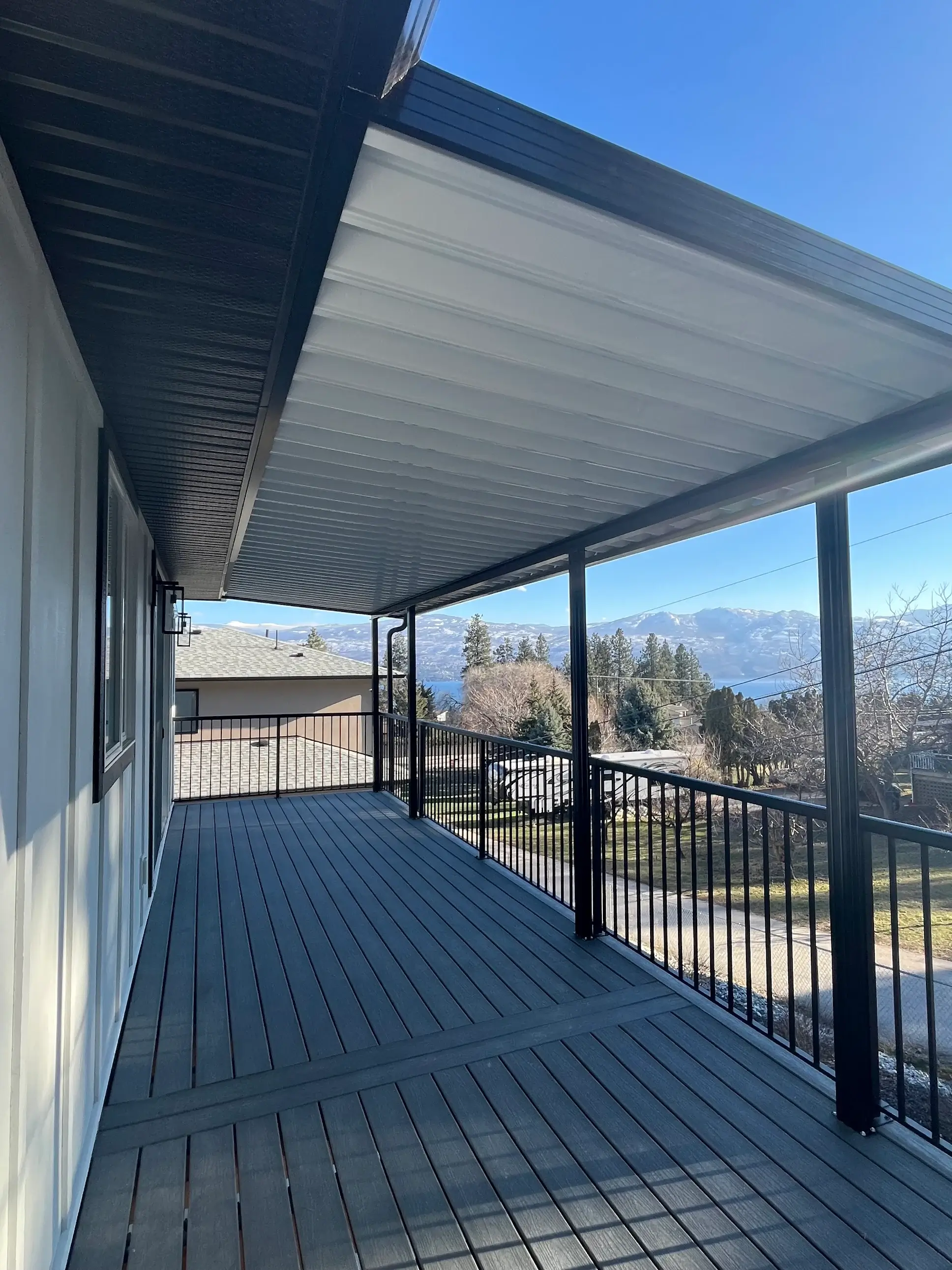
This is our most-installed style by a wide margin. Flat-roof solid aluminum panels create a clean, horizontal roofline that pairs perfectly with modern and contemporary homes. The panels are thick, solid aluminum and stay quiet during rain. No drumming on a tin roof.
Flat panels work because they don’t compete with your home’s roofline. They sit low and subtle. The underside can be smooth or textured, and you can run recessed LED lights directly into the panels for a built-in look. Most popular colours: matte black, charcoal, and custom colour matches.
Winter note: flat-roof covers in the Okanagan have to stand up to real snow. Ours are over-built for BC winters, and we size the structure for your location so your cover holds up through a Kelowna winter without buckling.
Glass Panel Roofs
If natural light is your priority, glass patio covers deliver. Tempered glass panels let in full daylight while blocking rain and wind. The effect is dramatic: your covered patio feels open to the sky instead of boxed in.
Glass roofs work best for patios that don’t get direct afternoon sun. South-facing decks in the Okanagan will bake under a glass roof in July and August unless you add tinted or Low-E glass (an available upgrade). North and east-facing patios? Glass is perfect.
Cantilever / Post-Free Designs
Cantilever covers mount directly to the house structure with no front support posts. The result is a completely unobstructed view from underneath. No posts blocking your sightlines to the lake or garden.
This is a heavier-duty build. The cover has to be anchored into the house framing or a reinforced ledger board, and the span is typically limited to 10-12 feet without posts. But for smaller patios or decks where you don’t want columns breaking up the Okanagan Lake view? Hard to beat.
Mixed Material: Aluminum + Glass
Why choose when you can have both? A solid aluminum roof with glass skylight panels gives you shade where you want it and light where you need it. We typically install one or two glass panels near the house wall (where shade from the house already exists) and solid panels on the outer section.
This is one of the best modern patio cover designs for homeowners who want the weather protection of aluminum but don’t want to give up all their natural light. It’s a smart compromise.
Traditional & Classic Patio Cover Designs
Not every home calls for a modern flat-roof look. If your house has a gable roof, dormers, or traditional architecture, these patio cover styles will blend in instead of standing out.
Gable Roof Patio Covers
A gable (peaked) roof on your patio cover mirrors the roofline of a traditional home. The peak adds vertical space underneath, which makes the covered area feel bigger and allows better airflow. Hot air rises and moves out through the ridge rather than sitting against a flat ceiling.
Gable covers built with solid aluminum panels look nearly identical to conventional shingled roofs from the ground. They shed snow and rain naturally because of the slope, and the peak can be oriented to match your home’s existing ridgeline.
Hip Roof / Dutch Hip
Hip roofs slope on all four sides. They’re more complex to build than gable roofs, but they’re also more wind-resistant and have a clean, polished look. Dutch hip designs combine a small gable peak at the top with hip slopes below. Classic choice for craftsman and colonial-style homes.
If wind is a factor on your property (and it is on many hilltop lots in West Kelowna and Vernon), a hip roof handles gusts better than a flat or single-slope design.
Attached Lean-To (Skillion)
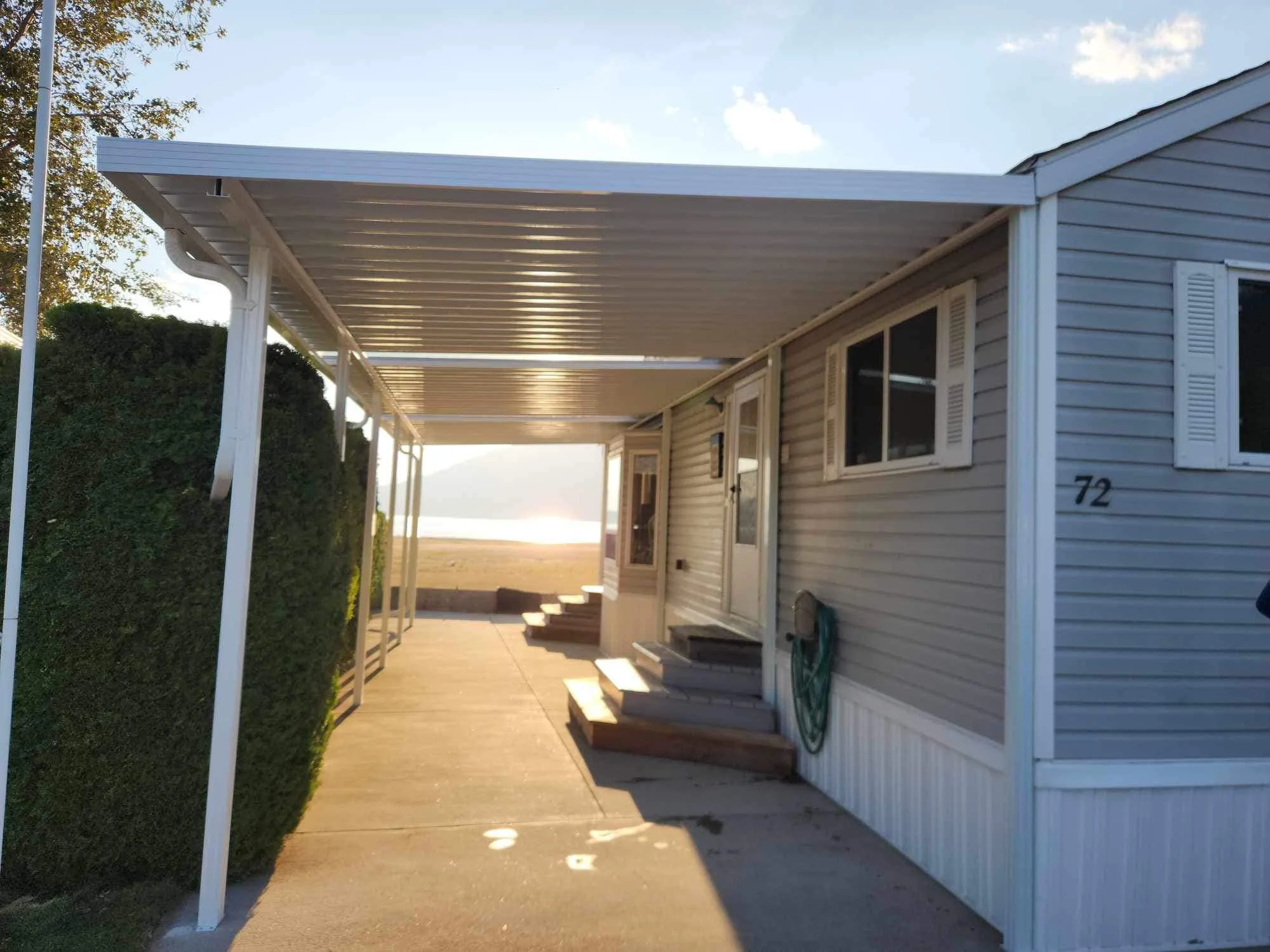
The lean-to is the simplest traditional design: a single-slope roof that pitches away from the house. It’s clean, it works, and it’s the most budget-friendly option in most cases. The slope can be steep or gentle depending on your aesthetic preference and snow load requirements.
Most of the patio covers we build are technically lean-to configurations. The difference between a “basic lean-to” and a “modern flat-roof” is really about pitch angle, material choice, and finishing details. A low-pitch lean-to with solid panels and matte black finish looks modern. A steeper pitch with white panels and exposed rafters looks traditional. Same concept, different execution.
Lattice / Open-Top Pergola Style
Worth mentioning because homeowners ask about it, but I’ll be honest: open-top pergola designs don’t provide real weather protection. They give you filtered shade and a nice garden aesthetic, but rain goes right through. In the Okanagan, where we get serious afternoon thunderstorms in summer and five months of snow, an open pergola limits how much you’ll actually use the space. If you want the pergola look, consider a solid aluminum cover with decorative rafter tails for the same visual effect with actual protection.
Rustic & West Coast Patio Cover Designs
The West Coast aesthetic is all about warm wood tones, natural materials, and blending with your surroundings. Problem is, real wood rots. Cedar looks incredible for about two years, and then you’re restaining every spring and replacing boards every five to seven years. Here’s how to get the look without the headaches.
Wood-Grain Finish Aluminum
This is the fastest-growing trend we’re seeing in BC right now. Aluminum patio cover panels with a wood-grain powder coating that mimics real cedar, walnut, or driftwood. The finish is baked on during manufacturing. UV-resistant, won’t peel, never needs staining.
From 10 feet away, most people can’t tell the difference between a wood-grain aluminum cover and real wood. Up close, you’ll notice the texture is printed rather than natural grain, but installed on a patio 8-10 feet above your head, the visual effect is convincing.
Most popular wood-grain colours: natural cedar, dark walnut, and grey driftwood. These pair well with stone patios, exposed aggregate, and cedar fencing. Exactly the combination you see on most West Kelowna and Lake Country properties.
Timber Accent + Aluminum Hybrid
If you want real wood in the mix, a hybrid approach works well. Use aluminum panels for the roof (where durability matters most) and real timber posts or decorative beams underneath. You get the warmth of natural wood where you can see it and touch it, and the zero-maintenance performance of aluminum where it’s exposed to weather.
Heavy timber posts (6×6 or 8×8 cedar or Douglas fir) add serious visual weight to a patio cover. They ground the structure and make it feel substantial. The wood components do need maintenance (stain or seal every 2-3 years), but you’re only maintaining a few posts, not an entire roof structure.
Warm Earth-Tone & Weathered Finishes
For homes with stone facades, log accents, or natural landscaping, warm earth-tone and weathered-look finishes tie everything together. These earthy tones recede into the background rather than demanding attention, which is exactly what you want if your backyard features rock walls, mature trees, or lake views.
Patio Cover Colour Options & Material Finishes
Colour choice makes or breaks a patio cover design. The wrong colour turns a great structure into an eyesore. The right colour makes it look like it was built with the house. Here are your options and how to choose.
| Colour | Best For | Style Match |
|---|---|---|
| Matte Black | Modern, contemporary homes | Flat-roof, modern |
| White | Traditional, bright spaces | Gable, lean-to |
| Sandstone | Classic, neutral palette | Any style |
| Custom Colour Match | Rustic, West Coast | Wood-grain hybrid |
| Charcoal | Modern, subtle contrast | Flat-roof, cantilever |
| Cedar Wood-Grain | Rustic, natural aesthetic | Timber hybrid, West Coast |
Standard vs Premium Finishes
Standard powder-coat colours (white, sandstone, charcoal, and matte black) come standard on every cover. These are the workhorses. Proven, UV-resistant, and available on every product line.
Premium finishes include wood-grain textures (cedar, walnut, driftwood) and custom RAL colour matching. Custom RAL means you can match literally any colour: your exact siding tone, your neighbour’s roof, whatever you need. Premium finishes are an upgrade, but the visual payoff is worth it on high-visibility projects.
How to Choose the Right Colour
Here’s the rule I give every client: match your patio cover to your fascia, gutters, or window trim. Not your siding. Your trim. These are the accent elements on your home’s exterior, and your patio cover is another accent element. When they match, everything looks intentional.
One thing to keep in mind for south-facing patios in Kelowna and Penticton: dark colours absorb more heat. A matte black cover over a south-facing deck will radiate heat downward on 35C days. Not a dealbreaker, but if you’re choosing between charcoal and white for a sun-blasted patio, lighter colours will keep the space cooler.
All OKPC finishes are UV-resistant and backed by a manufacturer warranty. They won’t peel, chip, or fade the way painted wood or vinyl does after a few seasons in BC sun.
Lighting Integration & Finishing Touches
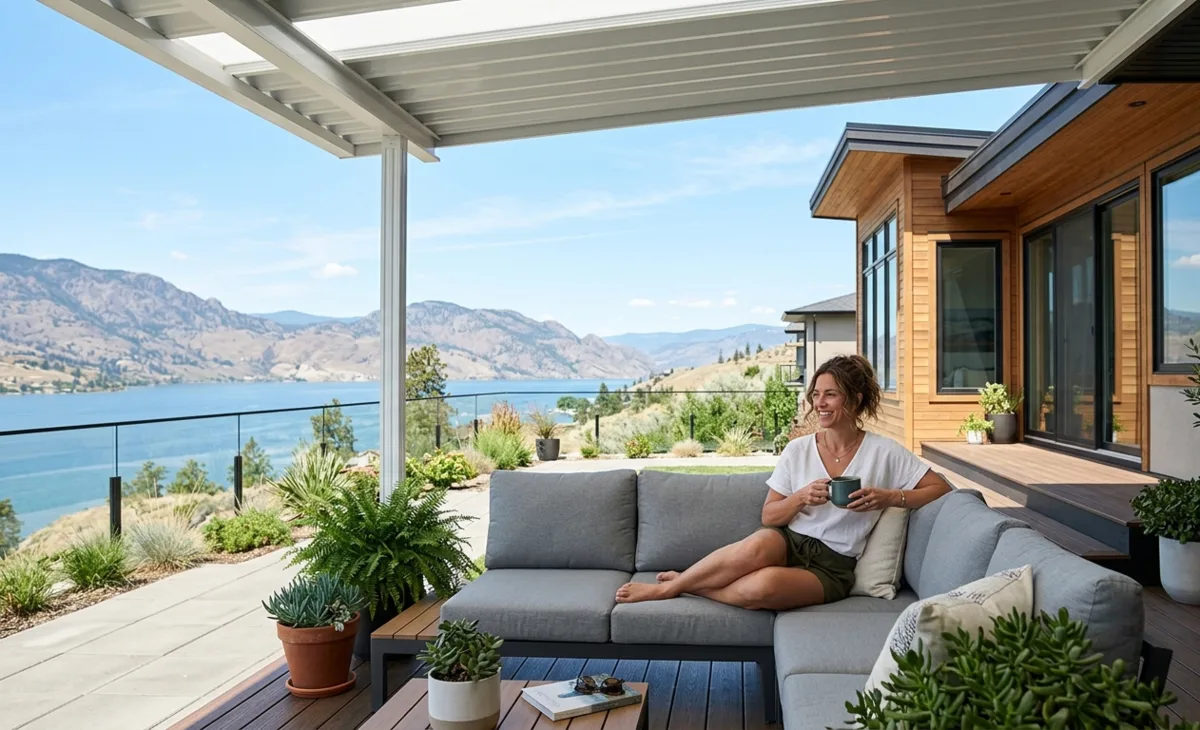
A covered patio without lighting is a covered patio you stop using at 8pm. In the Okanagan, summer sunsets don’t happen until 9:30 or later. Good lighting extends your usable hours by three or four hours every evening, and that’s worth planning for.
Recessed LED Pot Lights
The cleanest option. Recessed LEDs mount flush into the patio cover panels, so there are no hanging fixtures, no exposed bulbs, nothing to catch dust or cobwebs. They throw even, downward light that’s perfect for dining and entertaining. Most clients go with 4 to 6 lights depending on the cover size, and we include the wiring in the build.
LED Strip Lighting
Strip lighting runs along the perimeter or underneath beams for a soft, ambient glow. It’s not enough to read by, but it creates atmosphere. Waterproof LED strips in warm white (2700K-3000K) work well. Some clients add RGB strips that change colour for parties. Not my personal style, but it’s your patio.
Pendant & Hanging Fixtures
For a more traditional or decorative look, pendant lights or lanterns can hang from the cover structure. This works best over dining tables or conversation areas. Just make sure the fixtures are rated for outdoor use. Even under a cover, they’ll be exposed to humidity and temperature swings.
Ceiling Fans
Ceiling fans integrate easily into flat-roof covers and make a noticeable difference on still summer evenings. A good outdoor-rated fan moves plenty of air and makes a hot afternoon feel noticeably cooler. If your covered patio faces west and catches afternoon heat, a fan is well worth it.
Attached vs. Freestanding: Choosing the Right Layout
Before you pick a style or colour, you need to answer a more fundamental question: is your cover attached to the house or standing on its own?
Attached Patio Covers
Most of the covers we build are attached. They connect to your home’s exterior wall via a ledger board (a horizontal beam that’s lag-bolted into the house framing). The opposite side rests on posts set into footings.
- Best for: Back patios, deck covers, and extending the roofline over an existing concrete pad
- Look: Appears to be part of the house rather than an afterthought
- Requires: Proper flashing where the cover meets the house wall to prevent water intrusion
- Typical span: 10-16 feet from house wall to front posts
The key to a good attached cover is the connection point. If the flashing isn’t done right, water gets behind the ledger board and into your wall. This is one of the biggest reasons to hire a professional rather than going DIY. A bad ledger connection can cause thousands of dollars in water damage over time.
Freestanding Patio Covers
Freestanding covers stand on their own with 4 or more posts. No connection to the house. They go anywhere in your yard: over a pool area, beside an outdoor kitchen, or in a garden retreat.
- Best for: Pool areas, outdoor kitchens, fire pit zones, or spots away from the house
- Look: Pavilion or cabana style, a destination in the yard
- Requires: Proper footings on all four (or more) posts, plus more material since there’s no shared wall
- Flexibility: Can be oriented in any direction and placed anywhere on the property
Freestanding covers cost more than attached ones of the same size because you need more posts, more footings, and more structural bracing. But they give you placement options that an attached cover can’t match. If your dream is a covered lounge area next to the pool, 30 feet from the house, freestanding is your only option.
Get Inspired: See Real Okanagan Projects
Every patio cover we build is custom-designed for the specific home and property. No cookie-cutter kits, no one-size-fits-all packages. That means every project looks different, and there’s a good chance we’ve built something similar to what you’re imagining.
Browse completed projects in Kelowna, West Kelowna, Vernon, Penticton, and Lake Country in our project gallery. You’ll see flat-roof modern covers, traditional gables, wood-grain finishes, glass panels, and everything in between. All built for Okanagan homes and Okanagan weather.
If you’ve got a rough idea of what you want but aren’t sure which patio cover design ideas will work best on your home, that’s what the free design consultation is for. Describe your space, share a few photos, and we’ll give you a personalized recommendation with a quote. No pressure, no obligation.
Frequently Asked Questions
What is the most popular patio cover style in the Okanagan?
Flat-roof solid aluminum panels are the most popular choice for Okanagan homes. They offer clean, modern lines, are over-built for BC winters, and come in colours like matte black, charcoal, and sandstone. Solid aluminum panels are the top choice for homeowners who want a quiet, rain-tight cover. Flat panels account for the majority of what we install.
Can I get a patio cover that looks like wood but doesn’t need maintenance?
Yes. Aluminum patio covers with wood-grain powder coating look like real cedar or walnut but never need staining, sealing, or replacement. The finish is baked on during manufacturing and is UV-resistant, so it won’t peel or fade. It’s the top choice for homeowners who want the West Coast look without the yearly upkeep that real wood demands.
What colours are available for aluminum patio covers?
Standard options include white, sandstone, charcoal, and matte black. Premium wood-grain finishes (cedar, walnut, driftwood) and custom RAL colour matching are also available. We recommend matching your home’s fascia or trim colour for a cohesive look. Dark colours work best on modern homes; lighter tones suit traditional architecture. See our custom options page for the full selection.
Should I choose an attached or freestanding patio cover?
Attached covers connect directly to your home and are ideal for back patios and deck extensions. They create a natural transition from indoors to outdoors and are the most common choice. Freestanding covers work better for pool areas, outdoor kitchens, or spots away from the house. Most Okanagan homeowners choose attached covers for the integrated look and lower cost.
Can I add lights or a ceiling fan to my patio cover?
Absolutely. Recessed LED pot lights, strip lighting, pendant fixtures, and ceiling fans can all be built into aluminum patio covers. The key is planning electrical during installation rather than retrofitting later. We run wiring inside the cover structure so nothing is visible. Retrofitting after the cover is built typically costs double because panels need to be opened and resealed.
Ready to Design Your Patio Cover?
Get a free design consultation and quote. Tell us about your space and we’ll recommend the style, colour, and layout that fits your home. No pressure, no obligation.
Get Your Free Quote
Ready to Start Your Project?
Get a free, no-pressure quote. We’ll help you choose the right design for your home and backyard.
Serving Kelowna, West Kelowna, Vernon, Penticton, Lake Country & Salmon Arm